The Colosseum: A Journey Through Rome's Greatest Monument
The Colosseum: A Journey Through Rome’s Greatest Monument
Standing before the Colosseum on a crisp February morning, with temperatures reaching a comfortable 14°C, you can’t help but feel the weight of nearly two millennia of history. This iconic amphitheater, once the thunderous heart of Imperial Rome, continues to captivate visitors with its monumental presence and fascinating stories of triumph, tragedy, and transformation.
The Last Great Monument of Imperial Rome
Just steps away from the Colosseum stands the Arch of Constantine, built around 315 CE to commemorate Emperor Constantine’s decisive victory over Maxentius at the Battle of Milvian Bridge in 312 CE. This triumphal arch holds particular significance as it’s considered the last great monument of Imperial Rome. After Constantine’s reign, the empire began its steady decline in the west, though it would continue to thrive in Constantinople for another thousand years.
Understanding the Colosseum’s Battle Scars
The Missing South Wall: Nature’s Devastating Impact
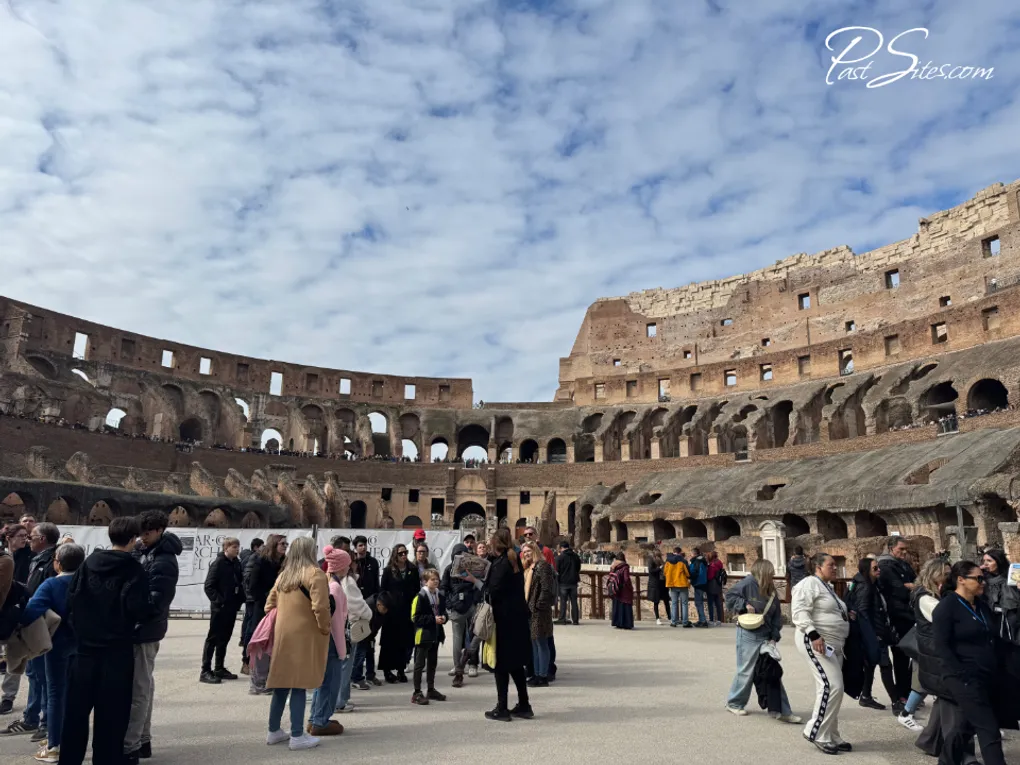
One of the most striking features of the Colosseum today is its dramatically damaged southern facade. While multiple earthquakes throughout history contributed to the structure’s deterioration, including significant tremors in 442, 484, 851, 1231, 1255, and 1703 AD. The most catastrophic event occurred in 1349 AD. This devastating earthquake completely collapsed the outer two walls along the entire southern facade, creating the dramatic partial ruin we see today.
The earthquake of 851 AD was particularly destructive, causing substantial structural collapse that permanently altered the building’s appearance. These natural disasters, combined with centuries of neglect, transformed the once-complete amphitheater into the romantic ruin that has inspired countless artists and writers.
The Mystery of the Holes: Medieval Scavenging
Visitors often notice the countless holes dotting the Colosseum’s travertine blocks. These aren’t random damage, they tell a story of medieval resourcefulness and survival. Originally, the massive stone blocks were held together by an ingenious system using 300 tons of iron clamps and dowels, assembled without mortar. During the Middle Ages, when metal became precious and scarce, these iron clamps were systematically extracted and melted down for reuse, leaving behind the characteristic holes we see today.
Engineering Marvels: The Velarium System
Among the Colosseum’s most impressive features was its retractable awning system, known as the velarium. This sophisticated shade structure was operated by a complex network of ropes anchored to 160 stone bollards positioned 18 meters outside the amphitheater’s perimeter in a radial pattern. These anchor points allowed operators to extend fabric awnings over the arena, providing relief from the Roman sun for up to 50,000 spectators.
Today, only five of these anchor bollards remain visible, primarily on the eastern side of the Colosseum, serving as silent witnesses to Roman engineering ingenuity.
Restoration in 17th and 18th century
Pope Pius VII was one of the first pontiffs to take serious action in preserving the Colosseum. A marble plaque mounted on the wall in 1807 commemorates his restoration efforts, which included commissioning the innovative “Stern buttress” on the northwest side. It was a crucial structural support designed to reinforce the weakening walls and prevent further collapse. These pioneering conservation efforts marked the beginning of systematic preservation that continues today.
Beyond the Arena: The Gladiator Quarter
East of the Colosseum lies an often-overlooked archaeological treasure: the Ludus Magnus. This was ancient Rome’s largest gladiatorial training school, built by Emperor Domitian. The facility was directly connected to the Colosseum via an underground tunnel, allowing gladiators to move between their quarters and the arena without passing through the crowds above.
Today, this area has become a popular spot for the modern tradition of love locks, where couples attach padlocks to nearby structures as symbols of their unbreakable bonds, a romantic custom that has spread to tourist sites worldwide.
Visiting the Colosseum Today
Ticket Information and Access
The Colosseum operates on a combined ticket system that includes access to both the amphitheater and nearby Palatine Hill. Depending on your ticket type, access is valid for either 24 hours or two consecutive days, though re-entry to individual sites isn’t permitted. From Palatine Hill, visitors can enjoy elevated views of the Colosseum and gain perspective on the broader archaeological landscape of ancient Rome.
Understanding Your Ticket Options
When booking through the official website (ticketing.colosseo.it), you’ll encounter several ticket tiers, each offering different levels of access:
Standard Admission The basic ticket provides access to the main Colosseum levels, Roman Forum, and Palatine Hill. Despite being the entry-level option, this ticket offers an excellent experience and represents great value for most visitors. You’ll be able to explore the corridors where ancient Romans once walked and gain a comprehensive understanding of the site’s history and significance.
Arena Experience This mid-tier option includes everything in the standard ticket plus access to the reconstructed arena floor, allowing you to stand where gladiators once fought. Arena tickets are released only 7 days in advance, which means they’re often available even when other options are sold out. While they may seem like a last-minute choice, arena tickets actually provide a unique perspective that many visitors find incredibly moving.
Full Experience (Underground and Attic) The premium option includes access to the underground hypogeum (where gladiators and animals were housed) and the upper attic levels. These tickets are released 30 days in advance and sell out quickly, often for the entire month within hours of release.
Booking Strategy and Availability
The ticket release schedule significantly impacts availability and your booking strategy. Since underground and attic tickets are released 30 days in advance, they’re typically sold out well before most travelers finalize their plans. This has created a common misconception that the Colosseum is always fully booked.
In reality, arena experience slots are often abundant and available as early as the next day. Many tourists, unaware of the different release schedules, assume they need to book expensive third-party tours when perfectly good official tickets remain available.
Insider Tip: Don’t overlook the arena experience if the full underground tour is unavailable. While the underground levels offer fascinating insights into the Colosseum’s operations, the arena floor provides an equally powerful connection to history. Standing where gladiators once stood, looking up at the surrounding tiers where 50,000 Romans cheered, can be just as emotionally impactful as exploring the chambers below.
The standard admission ticket, combined with some research beforehand, can provide a thoroughly satisfying visit. Unless you’re particularly passionate about seeing the underground mechanical systems that operated the arena, the regular ticket offers excellent value and access to the most iconic views and experiences the Colosseum has to offer.
Ongoing Restoration
The Colosseum remains a living monument, with extensive renovation and restoration work continuously underway. These efforts ensure that future generations will continue to experience this architectural marvel much as we do today. The sight of construction equipment and scaffolding serves as a reminder that preserving such an ancient structure requires constant attention and modern expertise.
The Enduring Power of the Colosseum
Standing in the shadow of this monumental structure, particularly from the northern perspective where you can clearly see all three levels where ancient Romans once walked to reach their seats, it’s easy to imagine the thunderous roar of 50,000 spectators cheering for their favorite gladiators. The Colosseum’s ability to evoke such vivid images of the past while serving as a symbol of human achievement and endurance makes it truly one of the world’s most remarkable historical sites.
Whether you’re exploring the exterior walkways, marveling at the engineering solutions that made such massive construction possible, or simply contemplating the layers of history embedded in every stone, the Colosseum offers an unforgettable journey through time. Each visit reveals new details and perspectives, ensuring that this ancient wonder continues to inspire and educate visitors nearly two thousand years after the last gladiator walked its sands.
Planning a visit? The Colosseum is typically less crowded during the winter months, offering a more intimate experience with this architectural giant. Don’t forget to explore the surrounding area, including the Arch of Constantine and the remains of the Ludus Magnus, for a complete picture of ancient Roman life and spectacle.
Further reading (sources)
- UNESCO World Heritage Centre on the Historic Centre of Rome inscription that covers the Colosseum
- Parco archeologico del Colosseo for current visiting guidance from the archaeological park
- Parco archeologico del Colosseo with the Museum of the Colosseum on the second level