Beneath Notre-Dame: The 'Dig of the Century' and Where to See Roman Paris
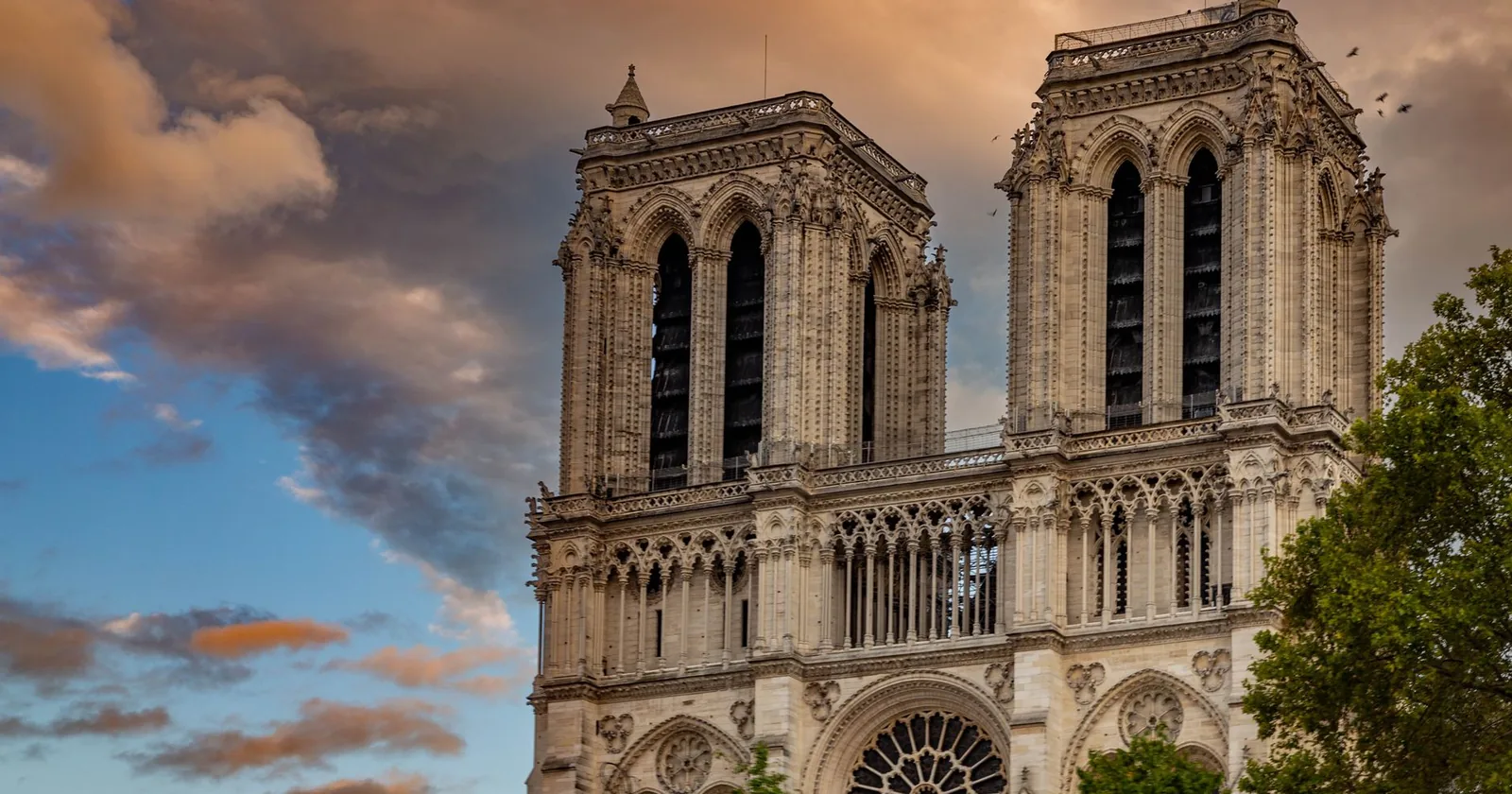
Wilting in the summer heat, a line of visitors curls across the square in front of Notre-Dame, waiting to climb the towers and meet the gargoyles. Four meters below their feet, a team of archaeologists is digging the other way, straight down and back in time toward the Roman city that stood here almost 2,000 years ago.
The cathedral burned in 2019, was painstakingly rebuilt, and reopened in December 2024. Now the city wants to soften its hot, bare forecourt with trees and shade. But in a place this old, you cannot turn the soil until you know what lies beneath it, so a slice of the parvis has become an open excavation, ringed by barriers and crossed by a wooden walkway just steps from the queue. French media have dubbed it the dig of the century. For travelers, it is a perfect reminder that the Gothic icon everyone photographs sits on top of a far older city, one you can still go out and see.
A dig born from a garden
The excavation itself is not a visitor attraction. It is rescue archaeology, the legally required look beneath the surface before construction, here ahead of a redesigned square planted with around 160 trees that should be finished by 2028. What the diggers are lifting out, though, is remarkable. The first traces appear barely 50 centimeters down; four meters lower, the team is still pulling up the past, sometimes filling 15 crates a day.
The layers read like a core sample of French history. Just below the modern surface lie the cellars of medieval houses that once packed the square. Beneath them sit Merovingian and Carolingian grain pits from the sixth to the tenth centuries, and deeper still, a dense Roman quarter from the fourth and fifth centuries. The richest finds come from the foulest spots: old latrine pits that doubled as rubbish dumps, where soft waste cushioned discarded jugs and cups so well that whole, unbroken vessels are coming up centuries later. Some carry faint reddish markings painted on the inside, on shard after shard, that no expert has yet deciphered.
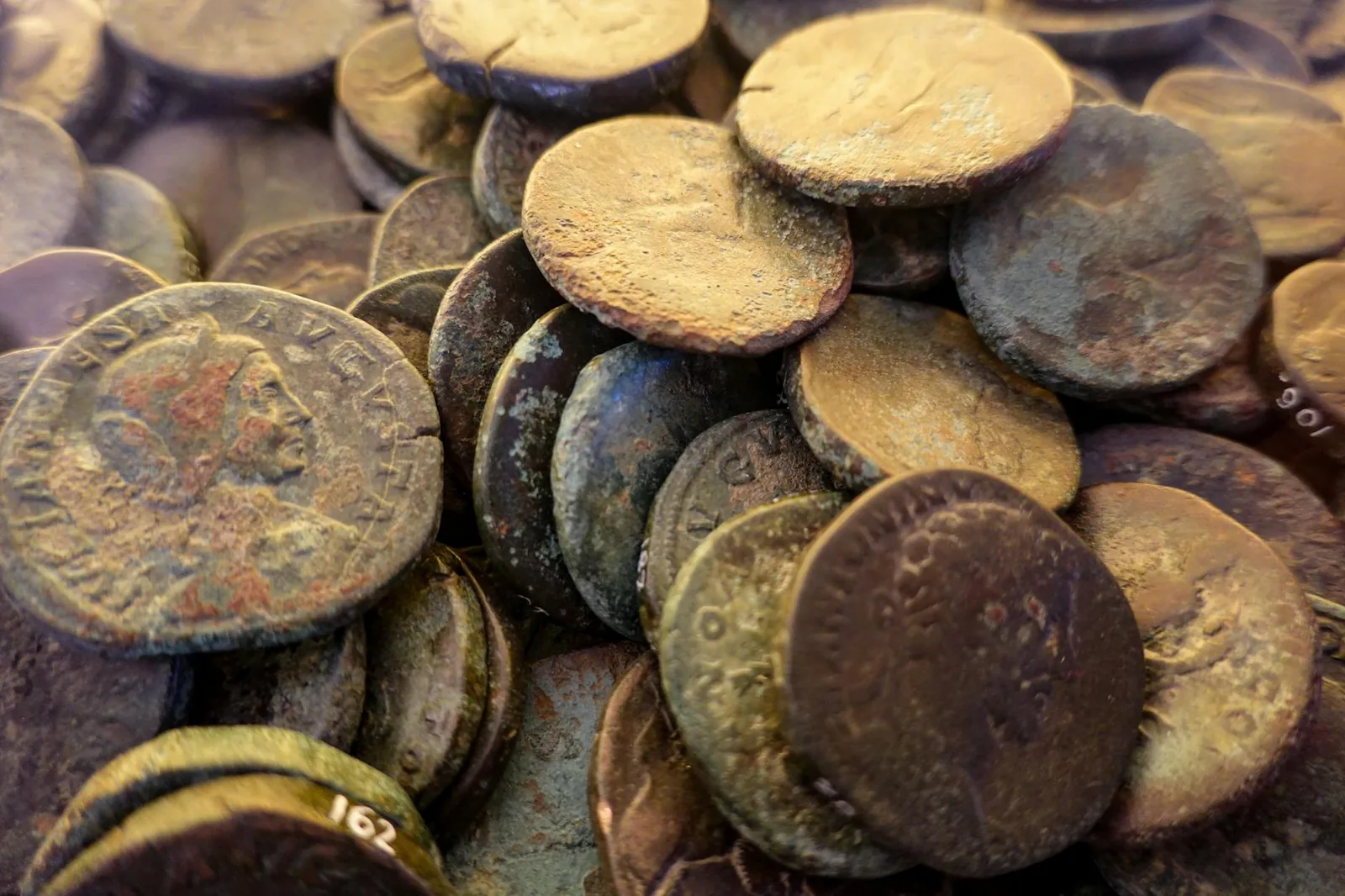
Then there are the coins. They emerge as black, rust-eaten discs, but under an X-ray one recently gave up a face: Constantine, the Roman emperor who ruled in the early 300s AD. Such coins are invaluable for dating the layer they came from. Every object is logged and carried north to the city’s archaeology center, a vast research store rather than a public gallery.
This is not the first time the ground under Notre-Dame has surrendered Roman Paris. In 1711, workers beneath the cathedral’s choir uncovered the Pilier des Nautes, the Boatmen’s Pillar, among the oldest carved monuments in the city. You can see it today, and I will come back to where.
Lutetia, the Roman city under Paris
Before Paris there was Lutetia, Lutèce in French. The name belonged first to the Parisii, a Gallic tribe who struck beautiful gold coins and gave the later city their own name. After the Roman conquest in the middle of the first century BC, a planned town rose on the Left Bank of the Seine, climbing the slope of what is now the Montagne Sainte-Geneviève. Its main north-south street, the cardo, ran roughly along today’s Rue Saint-Jacques. Its forum stood near the modern Panthéon, and it was served by baths, a theater, and an amphitheater.
For a long time people imagined Roman Lutetia crowded onto the Île de la Cité, but excavation has steadily corrected that picture: the monumental town spread across the Left Bank, while the island held a smaller settlement beside the river crossing. As the empire frayed in the third and fourth centuries, people pulled back to the island and fortified it with stone scavenged from older monuments. The current dig has turned up exactly that kind of recycling, a Roman doorstep lifted from some grander building, carried over, flipped upside down, and reset as paving in a road. It is a small, human trace of a city contracting in on itself.
Where to see Roman Paris today
The trench on the parvis will be backfilled, but three places let you stand inside Lutetia right now, and none asks you to leave the center of the city.
The Crypte Archéologique de l’Île de la Cité sits under the same square as the dig, at its western end, and should not be confused with it: the Crypte is a permanent museum, the dig a temporary pit a short distance away. Opened in 1980 around remains found while an underground car park was being excavated, it preserves Gallo-Roman foundations, a stretch of ancient quay and rampart, a room with its under-floor hypocaust heating, and layers stacked all the way up to the nineteenth century, viewed from raised walkways. It is run by Paris Musées, the Carnavalet network, and asks only a modest ticket (closed Mondays). Because it sits beneath an active works zone, confirm it is open before you go.
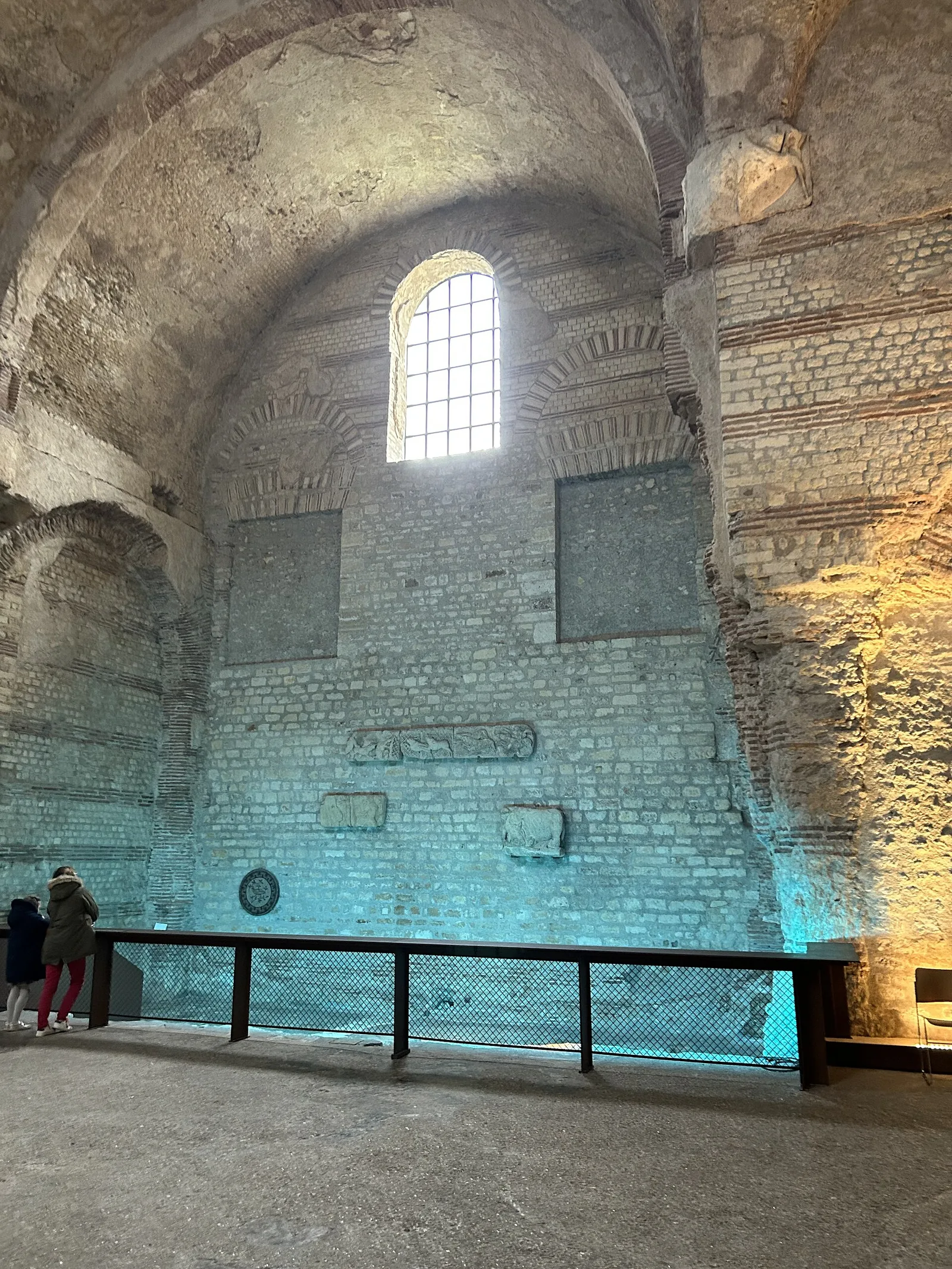
The Thermes de Cluny are the most complete ancient structure left standing in Paris. The frigidarium, the cold room of the Roman northern baths, still rises under its original stone vault about 14 meters overhead, built around the late first or early second century AD and probably paid for by the wealthy guild of river boatmen. The baths now form part of the Musée de Cluny, the national museum of the Middle Ages, which reopened in 2022 after a long renovation. This is also the home of the Pilier des Nautes, so the stone that came out of Notre-Dame’s foundations and the grandest Roman ruin in the city now share a roof. Just as the original frescoes of Knossos hang in a museum rather than on the palace walls, the Boatmen’s Pillar is displayed indoors here, not where it was found. Expect a paid, timed ticket, closed Mondays, and book ahead in summer. (The medieval half of the collection holds the celebrated Lady and the Unicorn tapestries, reason enough to linger.)
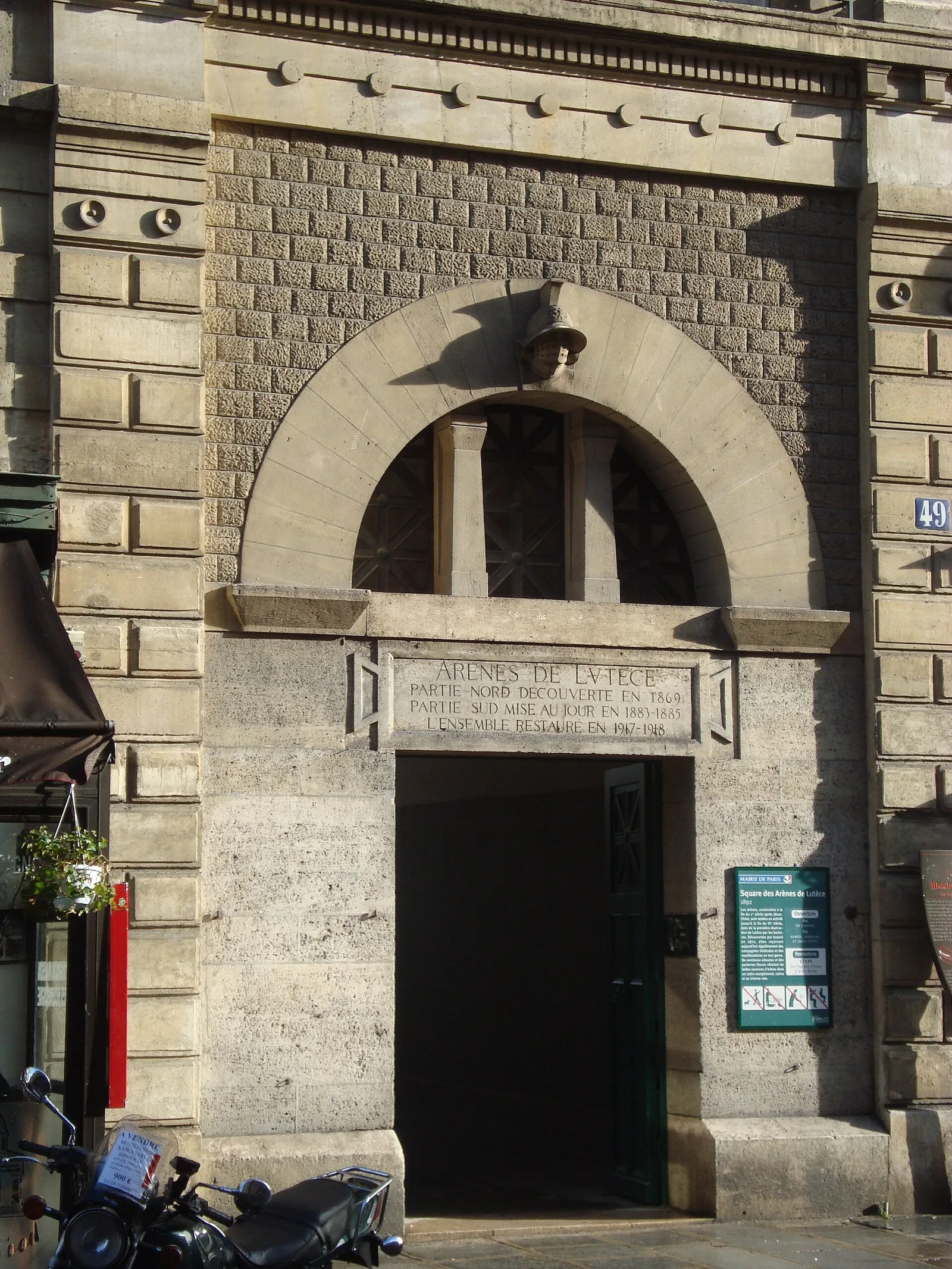
The Arènes de Lutèce is the amphitheater, raised in the first century AD, where as many as 15,000 spectators once watched gladiator fights and staged spectacles. Buried and forgotten for centuries, it was rediscovered in the 1860s when Rue Monge was cut through the quarter, and saved only after a public campaign that Victor Hugo lent his name to. What survives today is heavily restored, the tiers largely rebuilt, but the great oval shape is unmistakable, and best of all it is free: the arena is now a public garden where locals play pétanque and children chase footballs across the old performance floor. It is open daily until dusk, with entrances on Rue Monge and Rue de Navarre in the 5th arrondissement.
For a rainy afternoon, add the Musée Carnavalet, the free museum of the history of Paris in the Marais, whose Gallo-Roman gallery holds the Parisii gold coins, scale models of Lutèce, and prehistoric dugout canoes pulled from the riverbed at Bercy.
Planning an ancient-Paris day
The sites fall into two walkable clusters. On the Île de la Cité, pair Notre-Dame with the Crypte Archéologique beneath the parvis, then walk a few minutes to Sainte-Chapelle and the Conciergerie. The whole island belongs to the UNESCO World Heritage site “Paris, Banks of the Seine,” inscribed in 1991, a status that flags just how dense the history underfoot really is. If you enjoy planning trips around such listings, the World Heritage List keeps growing at the committee’s annual session each summer.
Cross to the Left Bank for the second cluster, the old heart of Lutetia: the Cluny baths, the forum’s buried footprint around the Panthéon, and the Arènes de Lutèce, all within a 20-minute walk of one another. That is a full, satisfying day of ancient Paris.
A few practical notes. Notre-Dame is free to enter, but demand has been intense since the 2024 reopening, so reserve a free time slot online, and book the tower climb, a separate paid ticket, well ahead. Spring and autumn bring softer light and thinner crowds than high summer, when the cathedral queue bakes in the open; go early or late in the day. The Crypte and Cluny are largely step-free after their renovations, but the Arènes has steps and uneven ground, and the towers are a stair climb only. Finally, remember that Notre-Dame is a working church: dress modestly, keep your voice down, and expect areas to close during services.
A city still being written
By 2028 the pit will be filled, the walkway gone, and 160 young trees will throw shade where the archaeologists now kneel. The Roman doorstep and the Constantine coin will rest in a store north of the city, cleaned and cataloged. But the real lesson of the dig holds for any traveler in an old city: the ancient world is rarely in a museum down the street. It is under the street. With the trench still open and Lutetia back in the news, this is a fine moment to go looking for it.
Further reading (sources)
- Inrap on the excavation beneath the Notre-Dame forecourt
- UNESCO World Heritage Centre for the Paris, Banks of the Seine listing
- Musée de Cluny with the national museum of the Middle Ages and its Roman baths
- Paris Musées details the Crypte Archéologique de l’Île de la Cité
Feature photo by Leonardo Delsabio on Pexels.