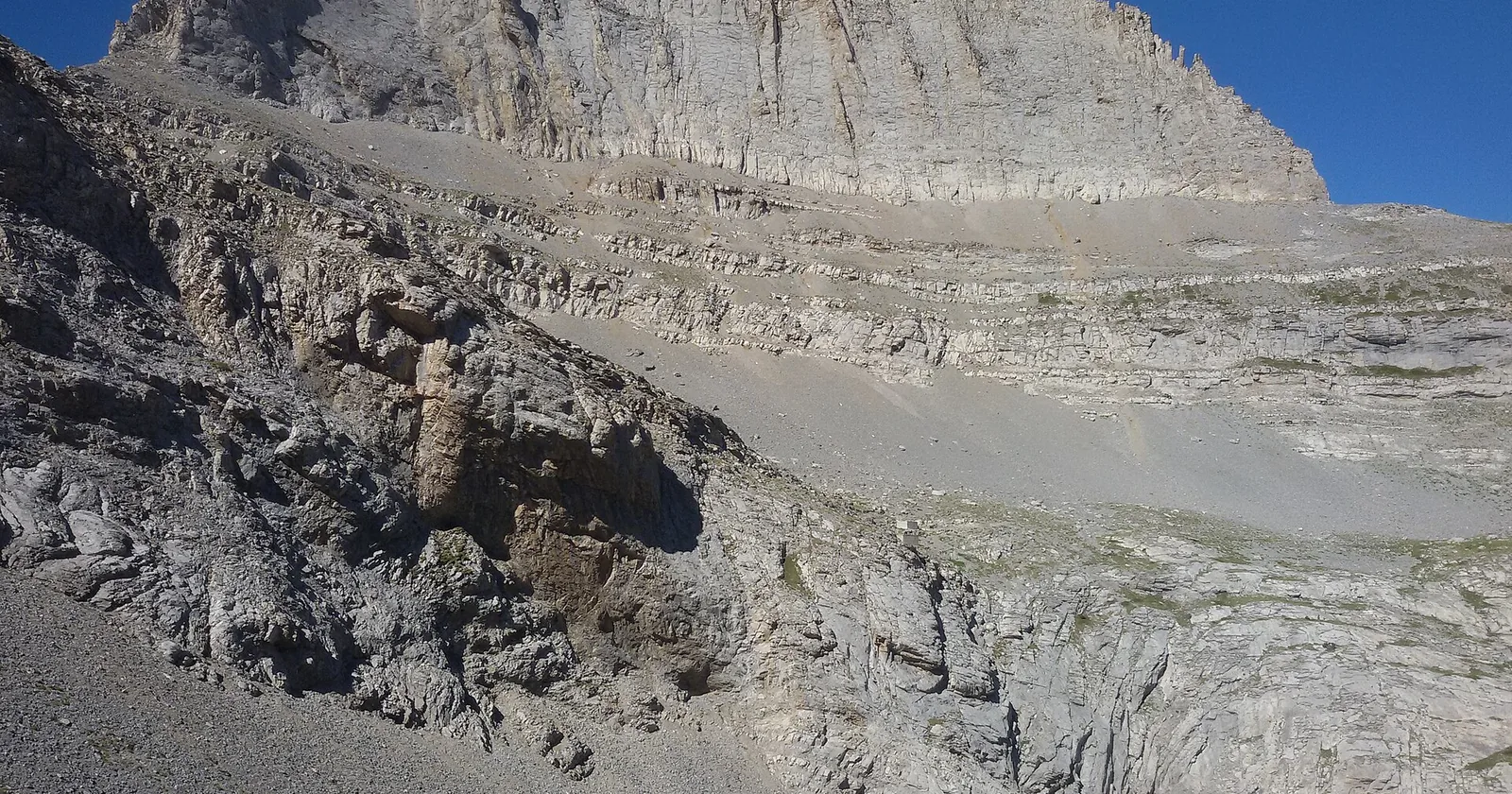
Mount Olympus Is a World Heritage Site: Climbing the Home of the Greek Gods
There are not many places where you can walk into a myth. Mount Olympus is one of them. The Greeks placed the throne of Zeus on its highest crag, gave the twelve Olympians a court up there among the mists, and then went on living in the villages at its feet, growing wheat on a plain that runs from the mountain to the sea. On July 26, 2026, at the 48th session of the World Heritage Committee in Busan, that arrangement was formally recognized. The Committee voted unanimously to inscribe the wider area of Olympus on the UNESCO World Heritage List as a mixed cultural and natural property, closing a campaign Greece began in 2014.
What UNESCO actually inscribed
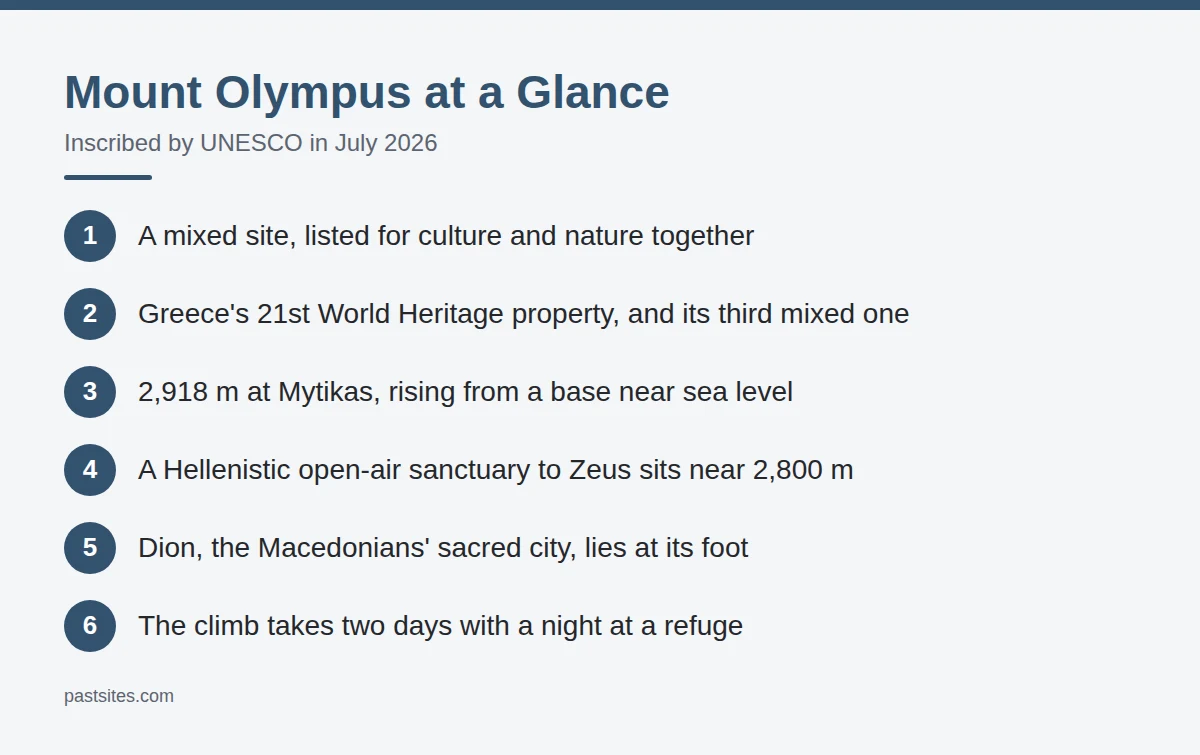
The word that matters in the citation is mixed. Fewer than forty of the more than 1,200 properties on the World Heritage List are inscribed for both cultural and natural value at once, and Olympus is only the third in Greece, after Meteora and Mount Athos. Greece put the file forward under four criteria covering the mountain’s association with living traditions and beliefs, its geology, its ecological processes, and its biodiversity. If you want the mechanics of how that works, we have a full explainer on the ten criteria and the nomination process.
The natural half of the case is easier to underestimate than the mythology. Olympus rises to 2,918 meters from a base that is practically at sea level, and that compression, sea to alpine summit in roughly twenty kilometers, produces an extraordinary ladder of climates and habitats. UNESCO singled out the microclimate created by the mountain’s proximity to the sea and its steep elevation gradient. The result is a refuge for species that retreated here and stayed, including plants found nowhere else on earth.
The vote was closer than the unanimity suggests. The advisory bodies had asked Greece for further detail, and a draft of the Busan agenda pointed toward referring the nomination back rather than inscribing it. The decision only came together in the final days of the session. Olympus is now Greece’s twenty-first World Heritage property, and it was one of 25 inscriptions from that session, which we walked through site by site in our verdict on the full 2026 intake.
The gods on the summit, and the archaeology of belief
The mountain’s cultural layer is not confined to Homer. On one of the lower summits, excavation has uncovered an open-air sanctuary whose earliest finds date to the Hellenistic period, between 323 and 30 BC. Greece’s nomination argues it is the sanctuary Plutarch described in the second century AD, when he wrote of processions climbing to a peak of Olympus to sacrifice to Zeus. Ash, burnt bone, and coins at nearly 2,800 meters are a strange and moving thing to think about while you are gasping up the same slope.
The sacred use never really stopped. A chapel on the peak of Profitis Ilias, at 2,803 meters, is believed to be the highest-altitude chapel in the Orthodox Christian world, which is its own kind of continuity: the sky god’s mountain kept a tenant. Lower down, the Enipeas Gorge holds the ruins of a monastery founded in 1542, and about twenty minutes further on, the Holy Cave of Saint Dionysios, a chapel built into the rock with a spring running out of it. The gorge walk from Litochoro is the best day on the mountain for anyone not going high, and it is where you feel most clearly that this is a worked, inhabited, prayed-in landscape rather than a scenic backdrop.
Dion, the sacred city at the foot of the mountain
If you visit one thing here besides the mountain itself, make it Dion. The archaeological park sits on the flat ground at the northern foot of Olympus, about fifteen minutes from Litochoro, and it covers roughly 75 hectares of a city that ran from the fifth century BC to the fifth century AD.
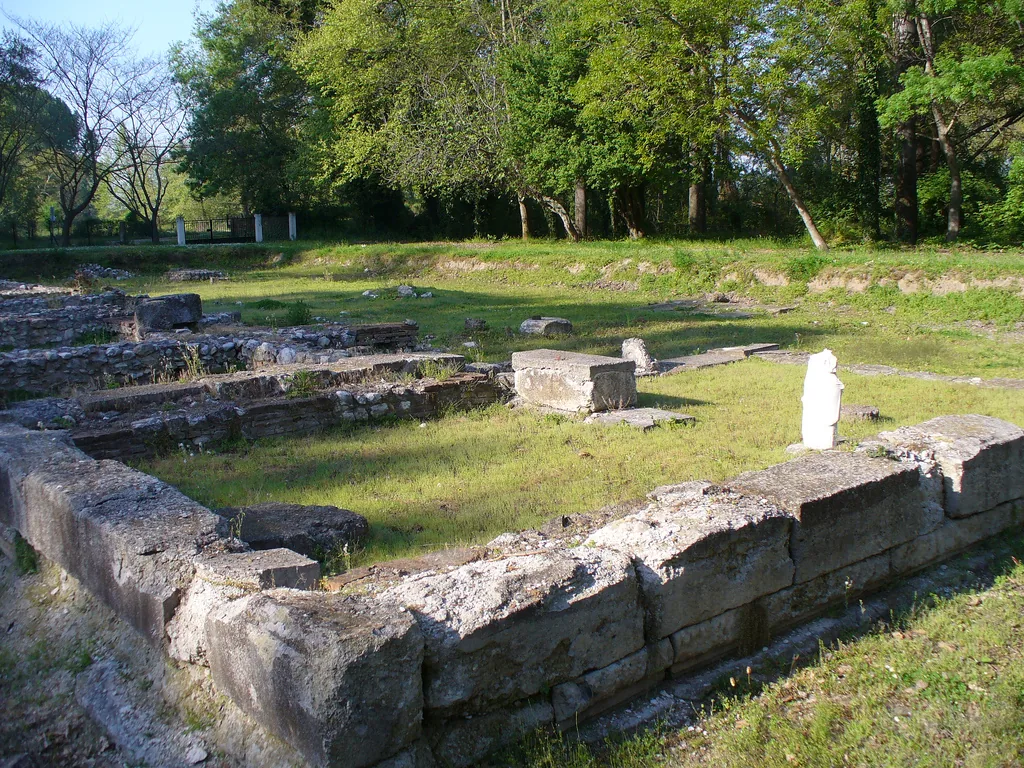
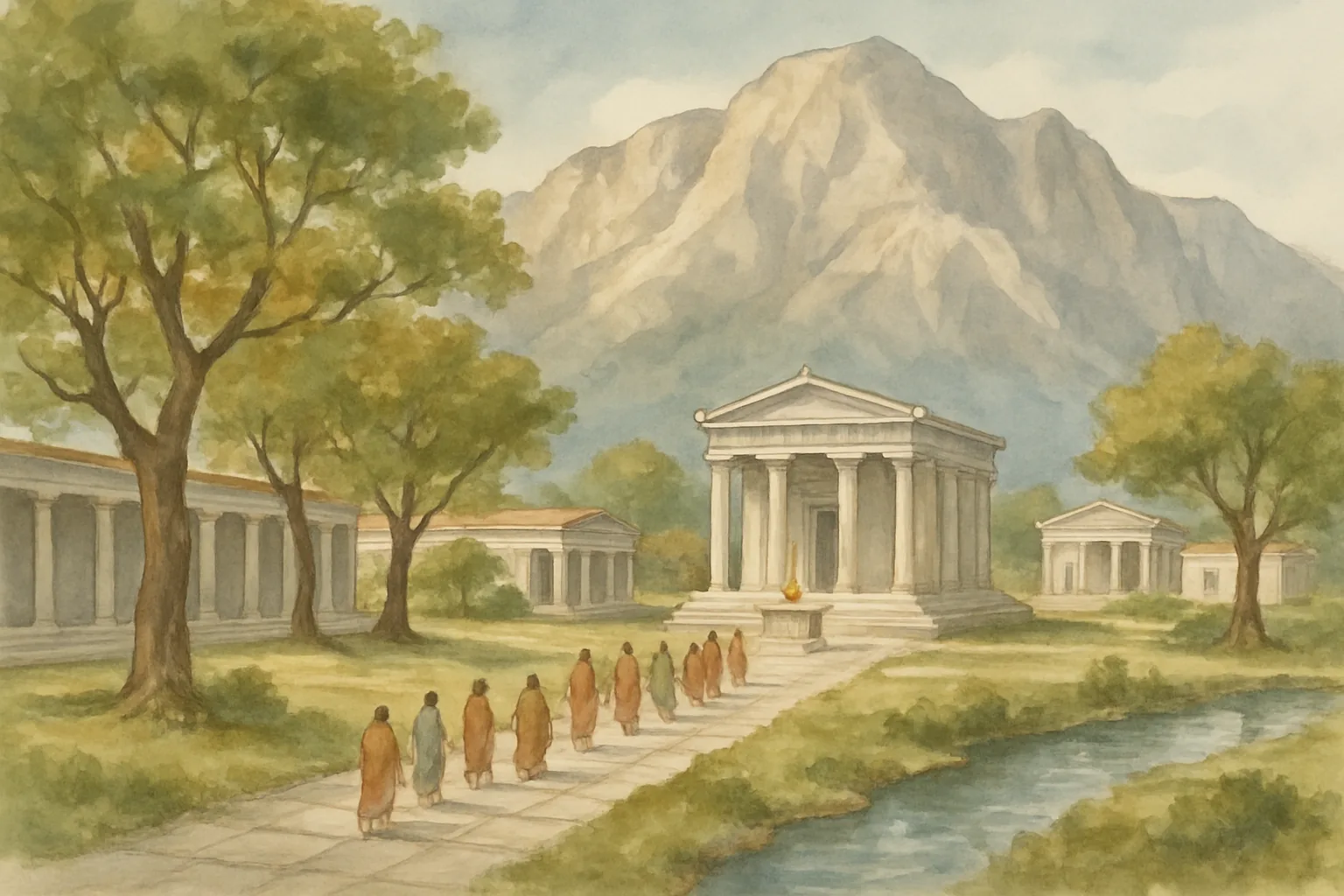
Dion was the sacred city of the Macedonians, the place their kings came to sacrifice to Zeus Olympios, purify the army, and swear oaths before campaigning. Alexander the Great held games here and made his own sacrifices to Zeus before crossing into Asia. That single fact reframes the whole plain: the launching point for the conquest of the Persian empire was a temple complex in the shadow of the gods’ own mountain.
What you walk through today is layered. There is the sanctuary of Zeus Olympios, the sanctuary of Demeter, and the strange, half-drowned sanctuary of Isis, three small temples reached by a raised walkway over standing water, because the water table here has risen and the springs that made Dion holy are now slowly reclaiming it. Then comes the Roman city that Augustus planted on top: the forum, the bath complexes, an odeon, a Roman theatre, and houses with mosaic floors. A Hellenistic theatre sits apart, with the mountain filling the view behind the stage.
Practicalities are easy. The park runs long summer hours, roughly 08:00 to 20:00 from mid-April to the end of October, and short winter hours with a Tuesday closure. A single ticket, under ten euros at the time of writing, covers the park and the archaeological museum in the village, which holds the finds including the remarkable bronze and wood hydraulis, an ancient water organ. Go to the museum first. The site is flat, green, shaded, and almost never crowded, which after Knossos or Delphi feels like a gift. Allow half a day for both.
The climb: Prionia to Mytikas
The standard ascent starts at Prionia, a road head at about 1,100 meters reached by a slow, narrow mountain road from Litochoro. From there the E4 trail climbs to the Spilios Agapitos refuge at roughly 2,100 meters: about 4.5 kilometers, three hours, and a steady grind through dense beech, fir, and pine. It is a well-maintained path and genuinely moderate. Most people sleep at the refuge and go for the summit at first light.
The second day is the one that needs honesty. From the refuge you climb to Skala, and from there to Mytikas at 2,918 meters is roughly three hours over about three kilometers. The final section is not a walk. It is an exposed scramble on loose limestone, hands out of pockets, with real drops beside you, and the alternative line through the Louki couloir is harder and more dangerous still. Technical climbing experience is not mandatory, but a head for heights is. Olympus has killed people, usually through some combination of sudden weather, loose rock, and an ambitious late start. Cloud can close on the summit ridge in minutes.
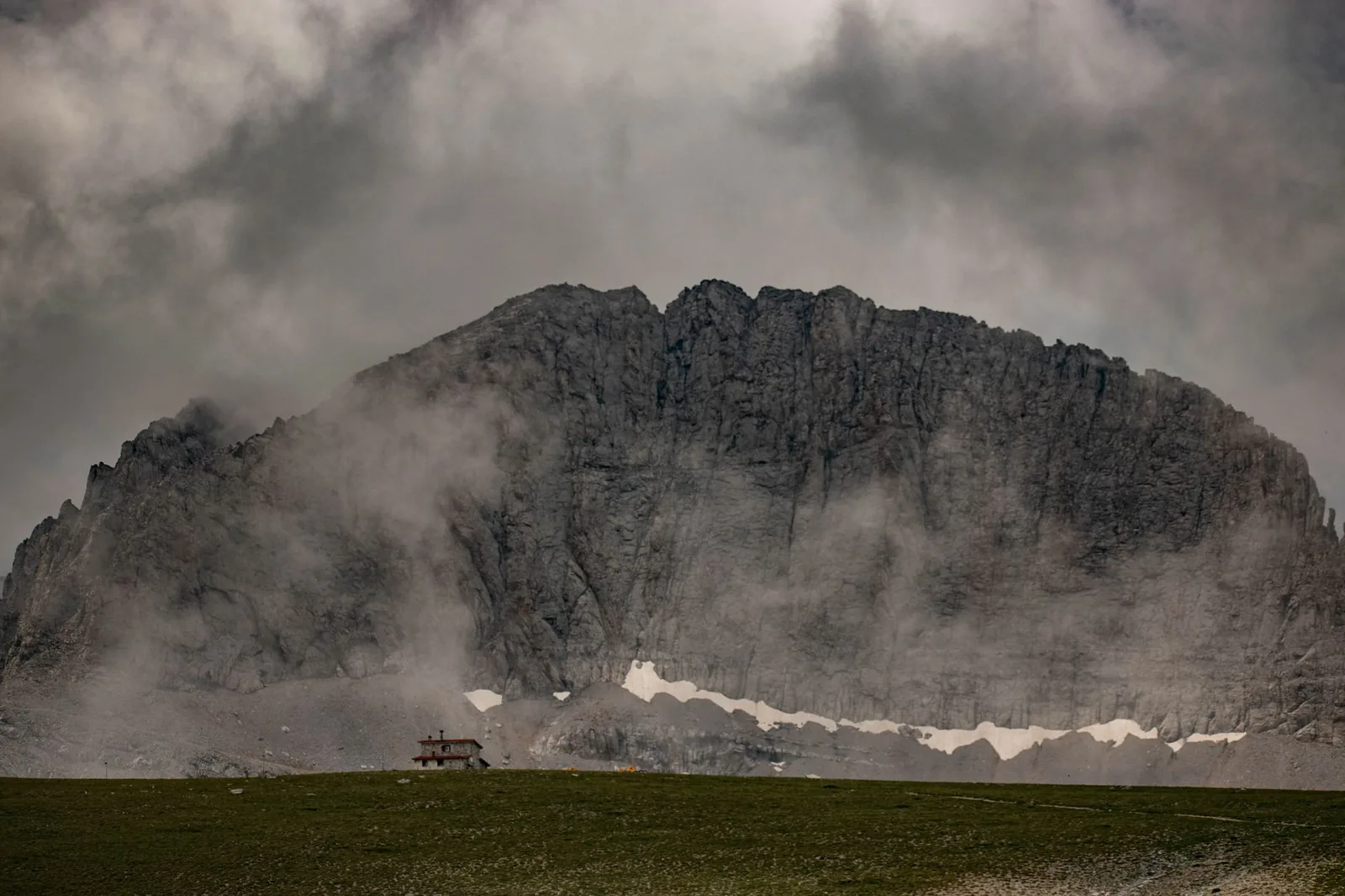
There is no shame in stopping at Skala or at Skolio, the second-highest peak, which is a walk rather than a scramble and gives you the full view down into the Kazania chasm and across at Stefani, the jagged ridge the Greeks called the Throne of Zeus. Plenty of people who reach the top say Skolio was the better summit anyway. Budget about two and a half hours back down from Mytikas to the refuge, and another two and a half to Prionia.
Refuges, season, and booking
The season runs roughly from June to early October, with the shoulder weeks at either end holding snow on the upper slopes. The refuges are the constraint, not the trail. Spilios Agapitos is the busy one on the main route, and its beds sell out for July and August well in advance, so book directly and book early. Higher up, the Christos Kakalos and Giosos Apostolidis huts on the Muses Plateau serve the alternative approach from Diastavrosi and are worth knowing about if you want a quieter two nights.
Take layers regardless of the forecast on the coast. It can be 33°C in Litochoro and near freezing with wind on the summit ridge the same morning. There is water at Prionia and at the refuge, and effectively none between the refuge and the top.
Making a week of it: Vergina and Pella
Olympus is the anchor of an ancient Macedonian circuit that most visitors to Greece never consider, because they fly to Athens and turn south. From Litochoro, the royal tombs of Aigai at Vergina are about an hour and a quarter by car. This is the one to prioritize: an underground museum built inside the burial mound itself, holding the gold larnax, gilded armour, and ivory portraits from the tomb of Philip II, Alexander’s father, all of it original and astonishingly preserved. Allow two to three hours.
Pella, Alexander’s birthplace and the Macedonian capital, is another forty-five minutes on, with a museum built around pebble mosaics from around 300 BC, the Stag Hunt and the Lion Hunt among them. Three days based between Litochoro and Thessaloniki takes in Dion, Vergina, Pella, and the Enipeas Gorge without hurrying, and you can bolt the climb onto the front or back of it.
For travelers who plan trips around fresh inscriptions, this pairs naturally with the other recent Greek addition, the six Minoan palaces of Crete, and it belongs to the same category of trip as walking India’s Buddhist circuit at Sarnath: a sacred landscape you move through on foot rather than a monument you stand in front of.
What the listing will change
It will bring more people. That is the point and also the problem. The president of the Litochoro Alpine Club has been blunt about it, asking how many visitors the ecosystem can actually carry, and noting that the existing national park rules on camping and swimming are already widely ignored. Local authorities have been weighing entrance fees and a visitor registration system, and a mountaineer who once opposed limits now argues for them.
Expect that to arrive. World Heritage status obliges the state, the region, and the municipality to protect what they nominated, and on a mountain where the pressure is physical footfall rather than looting, protection tends to mean numbers and permits. Which is the usual argument for going soon, with the usual caveat: go quietly, register where you are asked to, camp only where it is allowed, and spend your money in Litochoro rather than on the way through.
Further reading (sources)
- UNESCO World Heritage Centre on the nomination of the wider area of Mount Olympus
- Euronews for the Busan decision itself and what the citation says
- UNESCO World Heritage Centre with the record of the 48th Committee session
- Hellenic Heritage on what survives in the archaeological park of Dion
- Hellenic Ministry of Culture for the official site record for Dion
Feature Photo by Diomidis Spinellis, CC BY-SA 4.0, via Wikimedia Commons.