Sarnath Joins the World Heritage List: Walking India's Buddhist Circuit
On 25 July 2026, at the World Heritage Committee’s 48th session in Busan, the Ancient Buddhist Site of Sarnath became India’s 45th World Heritage Site. It is a listing that surprises people who know the place, not because Sarnath is unworthy but because most assumed it had been on the List for decades. Ten kilometres from the roar of Varanasi, in a walled park of clipped lawns and brick foundations, is the spot where a man who had just worked out what he thought was the shape of human suffering sat down with five former companions and explained it. Buddhism starts here, in a deer park, on an afternoon in the sixth century BCE.
What UNESCO actually inscribed
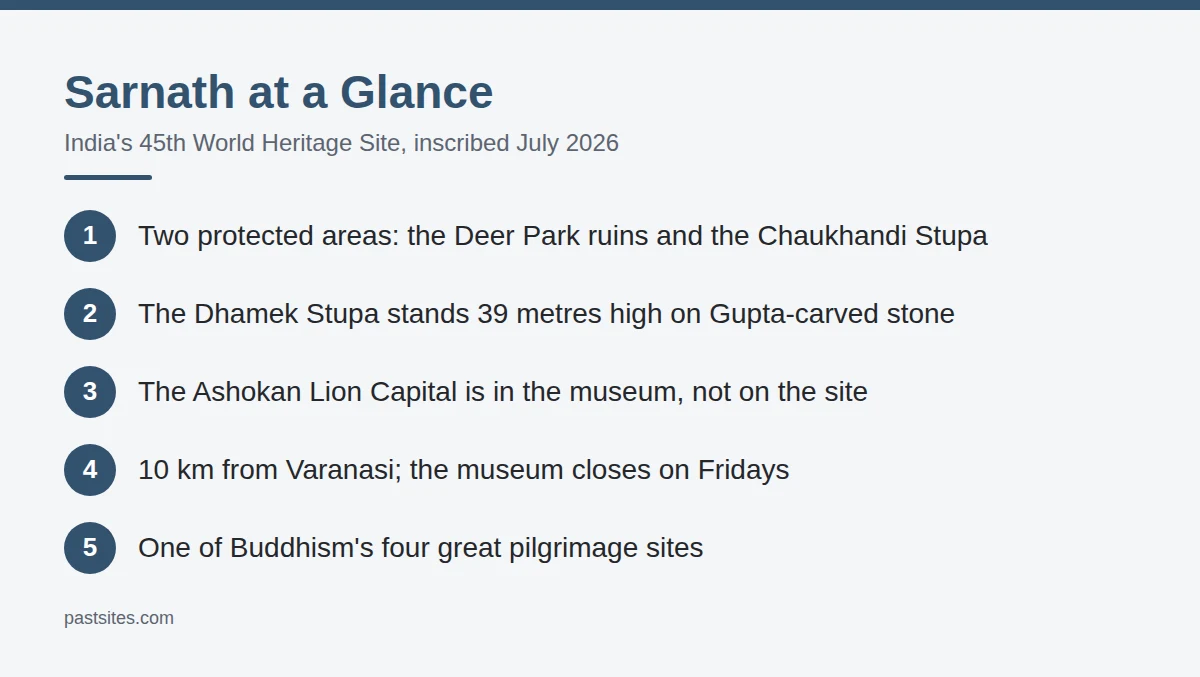
The property is not one monument but two protected archaeological areas, and knowing the difference saves confusion on the ground. The first is the Archaeological Remains of Sarnath, the main walled site containing the Dhamek Stupa, the ruined Dharmarajika Stupa, the stump of the Ashokan pillar, and the excavated footprints of monasteries and shrines. The second is the Chaukhandi Stupa, a separate mound about 800 metres down the road that most visitors drive straight past. Together they form the landscape known in the sacred texts as Deer Park, which appears variously as Rishipatana, Isipatana and Mrigadava depending on which tradition you read.
UNESCO’s Regional Office for South Asia framed the inscription around continuity: more than 2,500 years of pilgrimage, and temples, stupas and monasteries that record centuries of patronage. That patronage is the real story of the ruins. Sarnath was not built in one campaign. Ashoka came in the third century BCE, the Kushans and Guptas enlarged it, and it grew into one of the great teaching centres of the Buddhist world before being sacked in 1194 CE by the armies of Qutb ud-Din Aibak, after which it was quarried for bricks and forgotten. With Sarnath’s addition, the World Heritage List stands at 1,248 properties across 170 countries. If the mechanics of how a place gets there are new to you, our complete guide to the World Heritage system walks through the criteria and the nomination path.
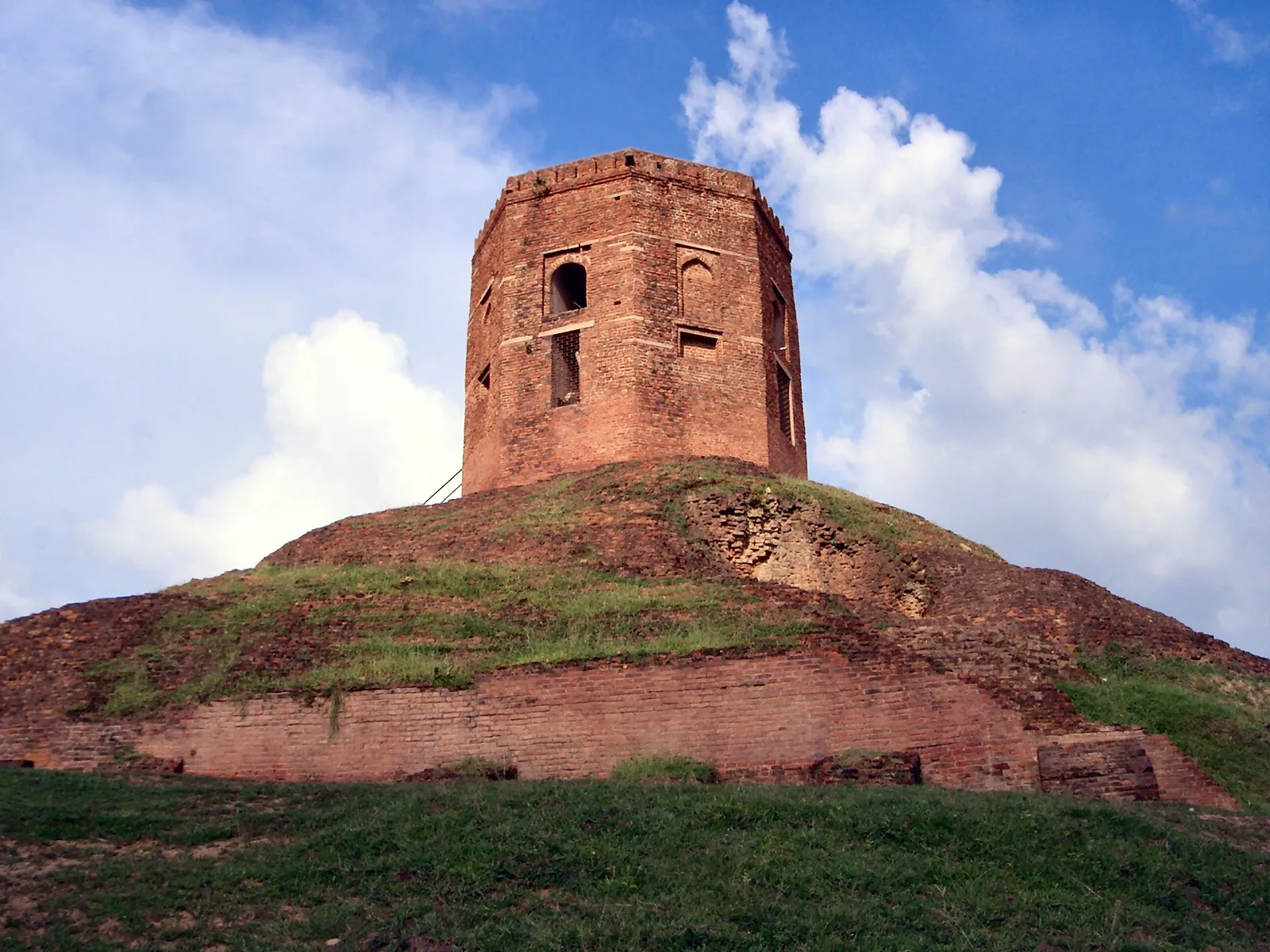
Chaukhandi is worth the five-minute detour precisely because it is odd. Beneath the grass is a terraced Gupta-era stupa marking where the Buddha is said to have rejoined his five ascetic companions. On top of it sits an octagonal Mughal brick tower, raised in 1588 CE by Akbar to commemorate a visit his father Humayun had made to the spot. Two empires, one mound, and a neat illustration of how these landscapes keep being reused rather than preserved.
Reading the ruins: the Dhamek Stupa
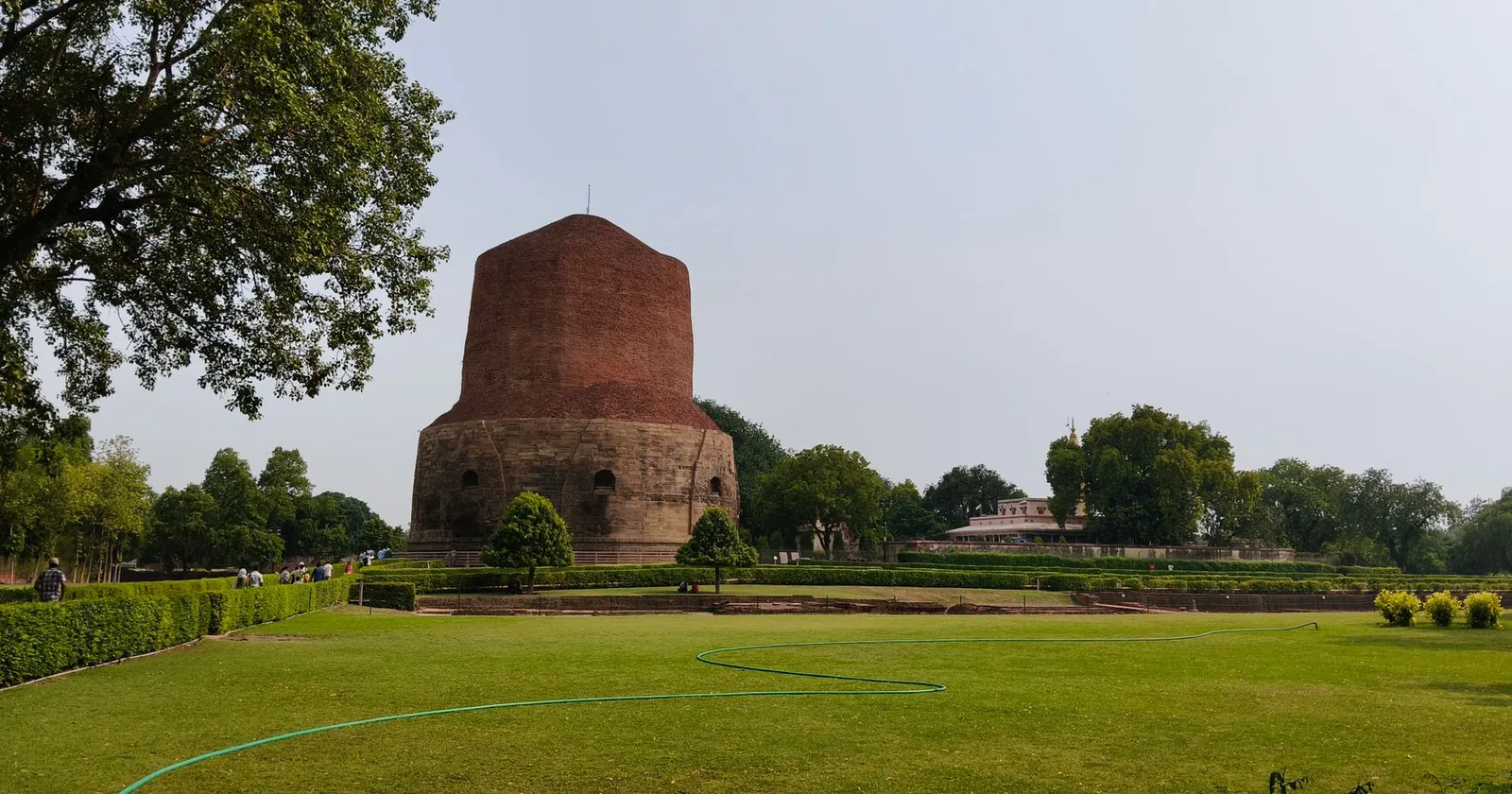
The Dhamek Stupa is the one on every postcard, and it earns its place. The drum stands about 39 metres high and 28 metres across, a solid cylinder of brick above a base of dressed stone. Look closely at that stone band: the carved floral and geometric panels are Gupta work of the fifth or sixth century CE, and the eight niches around it once held statues. The bricks above are older. Ashoka is thought to have modified an earlier structure here around 249 BCE, and what you see is the accumulated result rather than one architect’s design.
Everything else in the enclosure is foundation level, which is exactly why it repays a slow walk. The great ring immediately west of the Dhamek is the Dharmarajika Stupa, pre-Ashokan in origin and now nothing but its lowest courses. It was not time that did that. In 1794 the local ruler’s workmen dismantled it for building material and pulled a relic casket from the core, an episode that ironically triggered the first written record of Sarnath by the British resident Jonathan Duncan and set the site’s rediscovery in motion. Alexander Cunningham dug here in 1835 and 1836 and confirmed the identification.
Give yourself ninety minutes inside the walls. The monastery foundations to the north let you trace cells, courtyards and drainage, and because the lawns are open you can read the whole plan at once in a way you rarely can at a built-up site. Go at opening, roughly sunrise, or in the last two hours of daylight, when the brick turns red and the coach groups have gone.
The Ashokan pillar and the museum next door
Somewhere near the middle of the site, under a modest shelter, sits a stump of polished sandstone. This is what remains standing of the Ashokan pillar, erected around 241 to 233 BCE and broken during the twelfth-century destruction. It carries one of Ashoka’s edicts warning monks and nuns against splitting the community, and it is one of the most consequential broken objects in India.
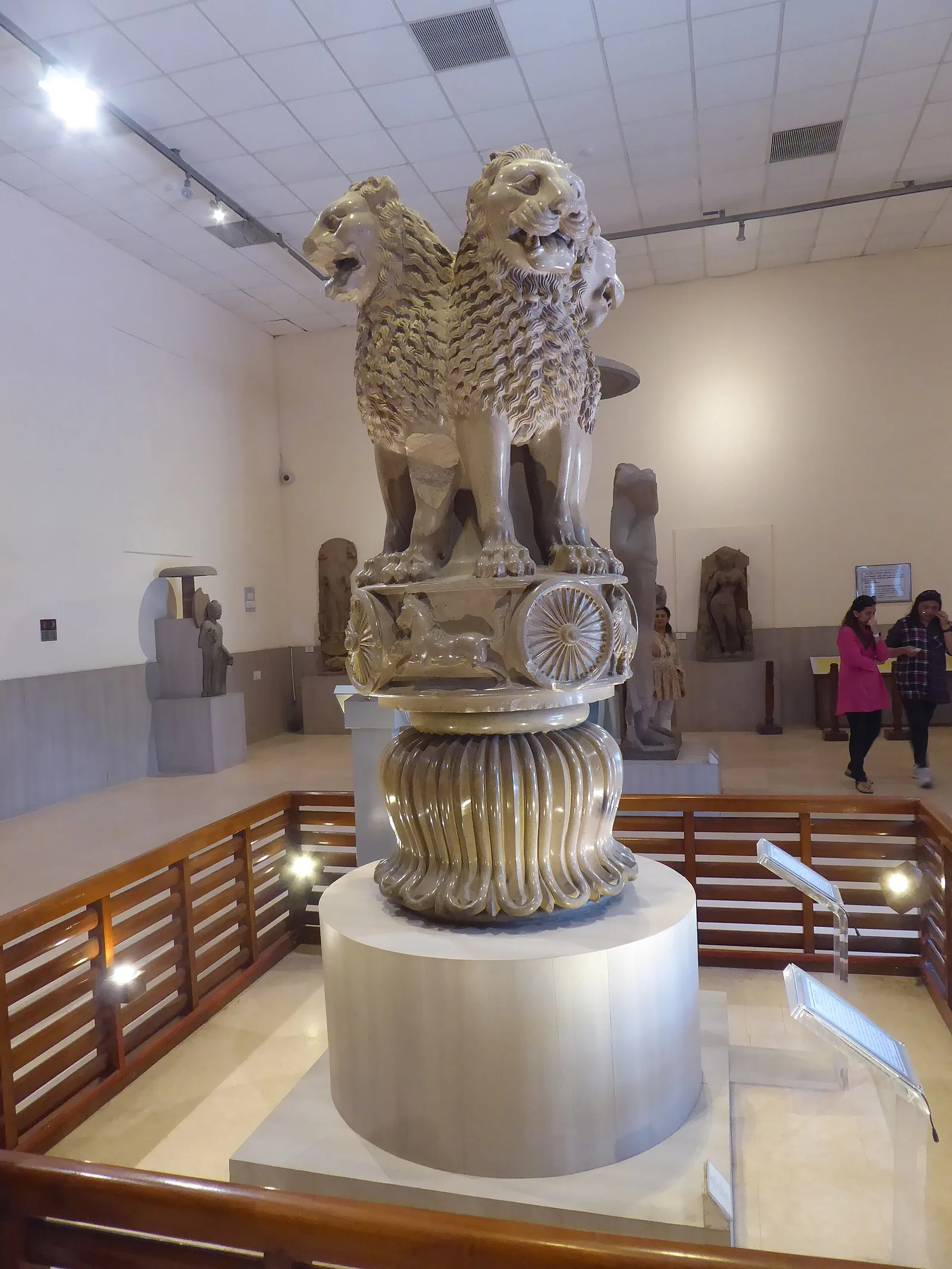
What crowned that pillar is now the emblem of the Republic of India. The Lion Capital, four lions back to back above an abacus carved with a lion, an elephant, a bull and a galloping horse separated by wheels, was pulled from the ground by F. O. Oertel in the 1904 to 1905 season. It stands today a two-minute walk from the site, in the Sarnath Archaeological Museum, along with the serene fifth-century Gupta Buddha shown preaching the first sermon, hands turning the wheel of dharma.
Do the museum first. It was purpose-built for this material, planned by John Marshall in 1905 and completed in 1910, which makes it the oldest site museum of the Archaeological Survey of India. Two practical notes: it closes on Fridays, and camera rules inside have changed more than once in recent years, so ask at the desk rather than assume. Seeing the capital and the preaching Buddha before you walk the ruins turns the foundations outside from rubble into rooms.
Note also what is not here. Sarnath’s material is scattered. Significant pieces sit in Kolkata, Delhi and London, a pattern familiar to anyone who has visited Knossos and then found its treasures in Heraklion. The museum next door holds the best of it, but not all of it.
Practicalities: getting there, tickets, etiquette
Sarnath is a half-day trip from Varanasi, about 10 km northeast, reachable by taxi or auto in thirty to forty minutes depending on traffic. Sarnath has its own small railway station, but almost nobody uses it; base yourself in Varanasi.
Entry is ticketed separately for the archaeological site and the museum, and both are cheap. Recent published rates run to roughly ₹20 for Indian nationals and ₹600 for foreign visitors at the site, with the museum around ₹25 and ₹300 respectively, though figures quoted online conflict and change. Buy at the counter and check the board. The site opens sunrise to sunset; the museum runs roughly 9am to 5pm and is shut Fridays.
The most important advice is not logistical. Sarnath is a working pilgrimage destination, not only a ruin field. On any given morning there will be monks and lay pilgrims from Thailand, Sri Lanka, Myanmar, Japan and Tibet circumambulating the Dhamek Stupa, and groups seated in prayer on the grass. Dress modestly, walk clockwise around the stupa as pilgrims do, do not photograph people at prayer without asking, and keep your voice down. The modern Mulagandha Kuti Vihara across the road, built in 1931 by the Mahabodhi Society and painted inside with murals by the Japanese artist Kosetsu Nosu, is an active temple with the same expectations.
Accessibility is better than at most ancient sites. The main enclosure is flat, grassed and laid with paths, so it is broadly manageable for wheelchair users, though the ground is uneven at the margins and the Chaukhandi mound involves a climb.
Fitting Sarnath into the wider Buddhist circuit
Sarnath is one of the four principal pilgrimage sites of Buddhism, the places associated with the Buddha’s birth, enlightenment, first sermon and death. Treated together they make one of the great overland heritage routes in Asia, and the new inscription is a good excuse to do the whole thing rather than a Varanasi day trip.
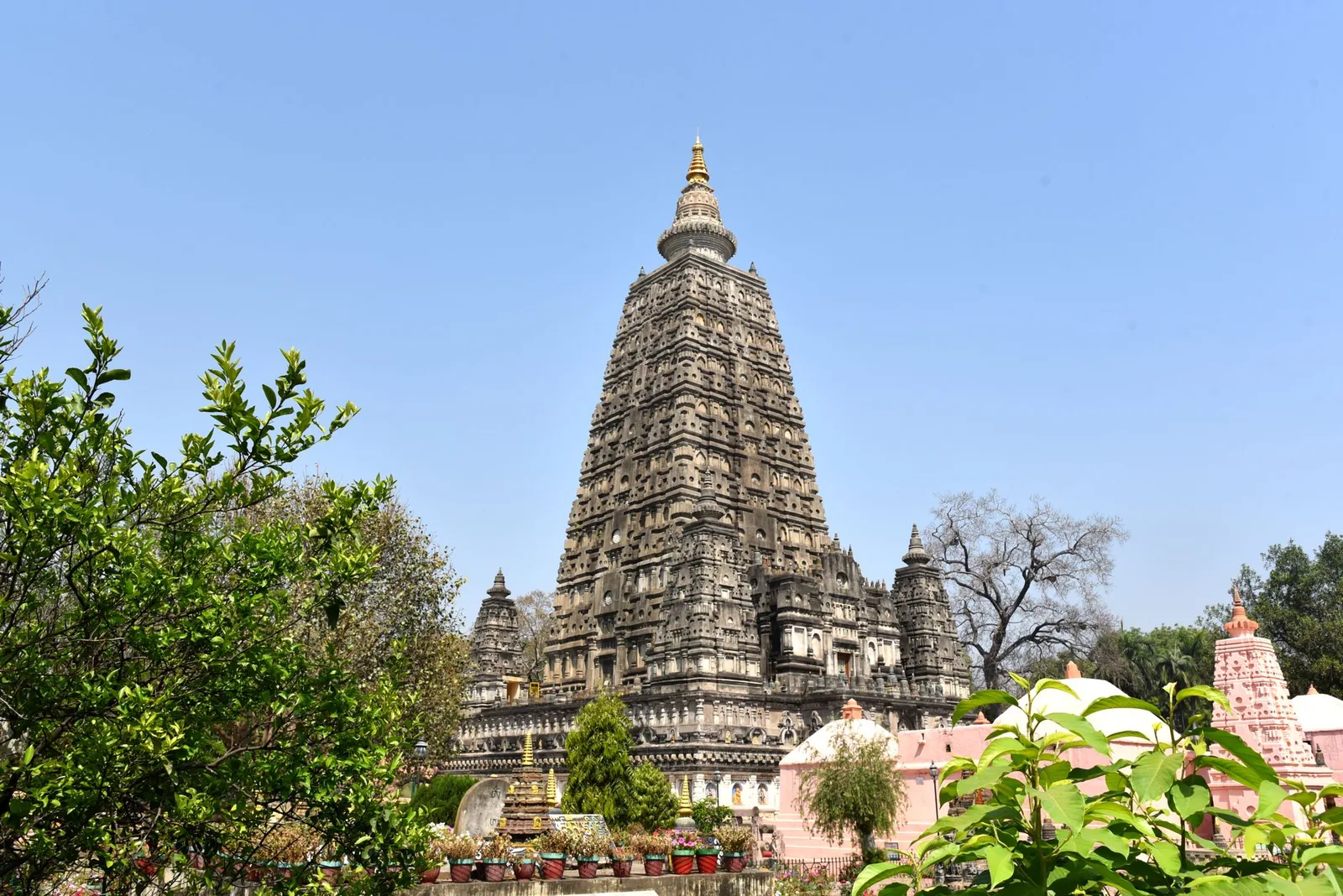
Bodh Gaya, about 250 km southwest of Varanasi, is the anchor. The Mahabodhi Temple Complex has been World Heritage listed since 2002 and holds the Bodhi tree under which the Buddha attained enlightenment before travelling to Sarnath. Allow two nights.
Nalanda and Rajgir sit between the two, an easy add from Bodh Gaya. Nalanda Mahavihara, listed in 2016, is the excavated brick skeleton of the most famous monastic university of the ancient world, and it is enormous. Half a day minimum.
Kushinagar, roughly 320 km from Bodh Gaya and about 270 km north of Varanasi, is where the Buddha died. Its reclining Buddha and Ramabhar Stupa complete the set. One caution worth stating plainly: the international airport built here in 2021 has had no scheduled commercial service since late 2023, and although new routes from Delhi keep being announced, you should plan to arrive by road.
Lumbini, the birthplace, is across the border in Nepal and was inscribed back in 1997. It adds a border crossing, so budget a full day of transit each way.
Sanchi is the outlier. Its Great Stupa and gateways, World Heritage since 1989, are arguably the finest Buddhist monuments in India, but they are in Madhya Pradesh, far off this route and best paired with a central India trip rather than bolted onto the circuit.
A workable self-driven version runs eight to ten days: fly into Gaya, two nights at Bodh Gaya with a Nalanda and Rajgir day, road or rail to Varanasi for two nights covering Sarnath and the ghats, then north to Kushinagar and out via Gorakhpur. If you would rather not organise it, IRCTC runs the Buddhist Circuit Tourist Train, a seven-night loop from Safdarjung station in Delhi that covers Bodh Gaya, Nalanda, Varanasi and Sarnath, Lumbini, Kushinagar and Shravasti. It is comfortable and comprehensive, and it moves fast.
November to February is the season. Days are warm and clear, mornings cool enough for early starts. April to June is punishing on the north Indian plain, and July to September brings the monsoon. Buddha Purnima, in April or May, fills Sarnath with pilgrims and is extraordinary to witness and difficult to move through.
Go now, or go later
Sarnath has been quietly accessible for a long time. That tends not to survive a World Heritage listing. Uttar Pradesh has been investing in Buddhist circuit infrastructure for years and now has an international designation to promote, so expect signage, facilities and visitor numbers to climb, and expect the site to be managed more intensively as they do. The Colosseum’s shift to timed entry is the standard trajectory, and if you want a sense of what heavy management eventually looks like, our guide to Rome’s amphitheatre covers it. Sarnath is nowhere near that yet.
For the moment the Deer Park remains what it has been for a century of excavation: a quiet green rectangle where you can sit on the grass near a 39-metre brick cylinder and think about the fact that an entire world religion began with one conversation on this ground. Sarnath was one of 25 properties added to the List in 2026, and our traveller’s verdict on the full 2026 intake covers the rest of that slate.
Further reading (sources)
- UNESCO on the announcement of Sarnath as India’s 45th World Heritage Site
- The Hindu for the inscription in the context of India’s full World Heritage list
- Smarthistory with an art-historical reading of the Lion Capital and its pillar
- Business Today on why Kushinagar’s airport has sat without flights
- Wikivoyage for a practical overview of the Buddhist Circuit route
Feature photo by Vishvajeet Kumar on Pexels.