Malta's Megalithic Temples: The World's Oldest Free-Standing Buildings, Island by Island
Most people arrive in Malta for the water. Blue Lagoon, Valletta’s harbour, a hire car and three beaches a day. Very few of them realise that a twenty minute drive inland stands a building that was already ancient when the first stone was laid at Giza. The temples of Malta and Gozo are the oldest free-standing buildings anywhere on earth, and they are not a single monument but a scattered family of them, spread across two small islands and startlingly easy to reach.
What UNESCO actually listed
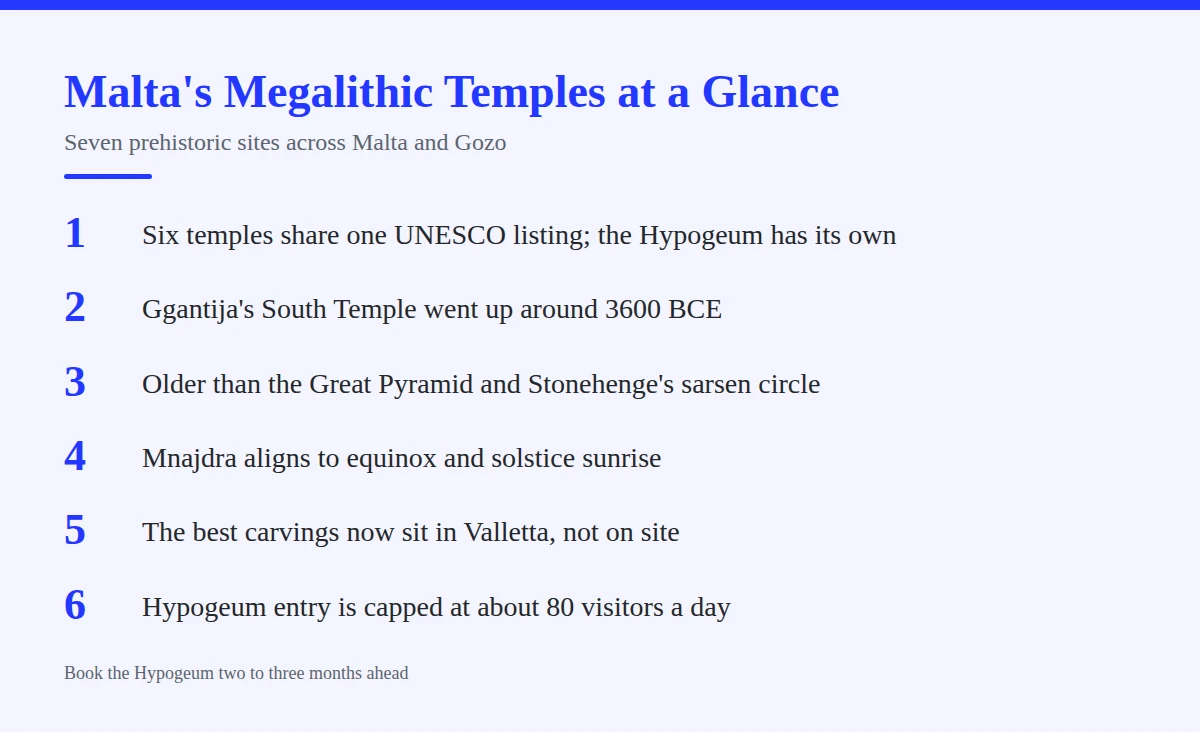
The World Heritage property is called the Megalithic Temples of Malta, and it grew in two stages. Ggantija on Gozo was inscribed alone in 1980. In 1992 the Committee extended the listing to take in five more sites on Malta itself: Hagar Qim and Mnajdra at Qrendi, Tarxien, Ta’ Hagrat at Mgarr and Skorba at Zebbiegh. Six sites, one property, listed under criterion (iv) as outstanding examples of a building type that has no parallel anywhere else.
The Hal Saflieni Hypogeum is not part of that group. It carries its own inscription, also from 1980, and it is a separate ticket, a separate booking system and, as you will see, a separate order of difficulty. If the mechanics of how sites join the list are new to you, my guide to how the World Heritage system works unpacks the criteria and what a listing obliges a country to do.
The dating is the part that stops people. Temple building on the islands ran from roughly 3600 to 2500 BCE. Ggantija’s South Temple went up around 3600 BCE, which puts it a full millennium before the Great Pyramid and several centuries before the sarsen circle at Stonehenge. The culture that built them then vanished around 2500 BCE, six centuries before the first palaces rose on Crete. Whatever ended it, and the candidates range from soil exhaustion and drought to disease and simple social collapse, the islands were resettled later by people with a Bronze Age toolkit and no apparent connection to the builders.
Ggantija, Gozo: start here
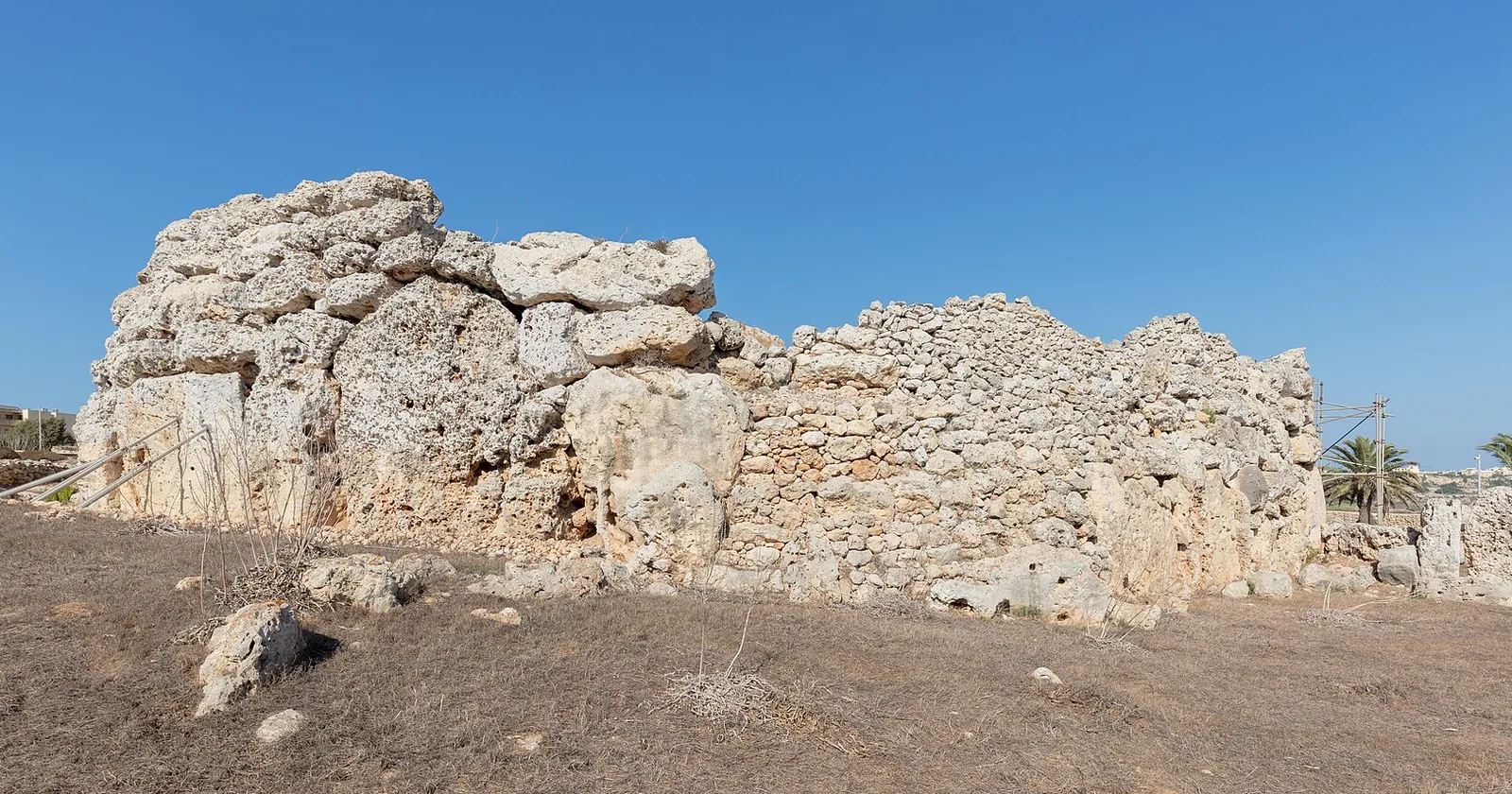
If you see one, see this one. Ggantija sits on the Xaghra plateau with the whole of Gozo dropping away beneath it, two temples inside a single boundary wall of coralline limestone blocks so large that Maltese folklore credited them to a giantess, which is where the name comes from.
The South Temple is the older and better preserved of the pair, and its plan is the template for everything else on these islands: an oval forecourt, a trilithon passage of two uprights carrying a lintel, then a lobed interior of apses opening off a central corridor. The South Temple has five of them, split by a second passage into a pair and then a trio. Altars and animal bone came out of these chambers, which is the evidence behind the word “temple”, though the label is a modern convention rather than something the builders left us in writing.
Practically, Gozo is a ferry hop. Cirkewwa to Mgarr harbour takes about 25 minutes, then bus 322 or 307 up to Xaghra. Adult entry is around 10 euro and the ticket also covers Ta’ Kola Windmill a few minutes’ walk away, which is a genuinely good folk museum and not a filler stop. The site has a modern visitor centre with the finds context you will want before you walk in. Nearby, the Xaghra Stone Circle, an underground burial complex of the same era, is an active research site rather than a visitable one, so expect a viewing platform rather than access.
Hagar Qim and Mnajdra: the cliff pair
On Malta’s southern coast, 500 metres apart on a slope above the sea with the uninhabited islet of Filfla offshore, sit the two temples most visitors photograph. They share one archaeological park, one ticket and one visitor centre.
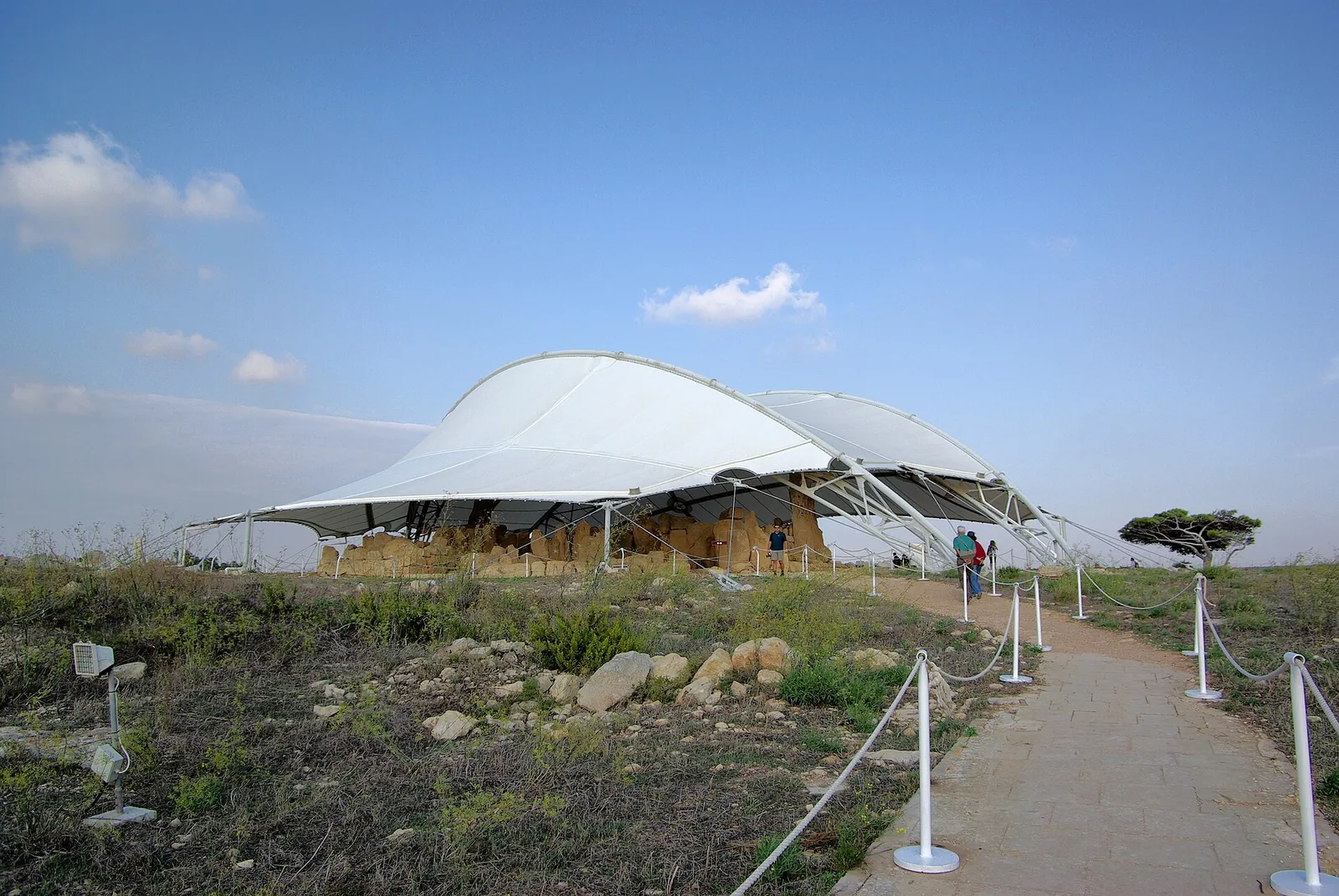
Those white canopies went up in 2009 and they divide opinion. Hagar Qim is built almost entirely of globigerina limestone, the soft honey coloured stone that gives Valletta its colour and that weathers alarmingly fast in salt wind. The shelters bought the monuments time. They also mean you will never photograph either temple against open sky, and the first sight of a tensile roof where you expected raw ruin is a jolt. Take the trade for what it is: the alternative was watching the carved surfaces dissolve.
Hagar Qim rewards slow looking. Its main temple has a paved central court of smooth slabs, an original four apses with more rooms added later, and near the trilithon entrance an altar carved with plant motifs in relief. The outer wall carries one of the largest single slabs ever raised on the islands. The famous corpulent figurines found here, the so-called fat ladies, are not on site. They are in Valletta, which is a pattern you will meet again.
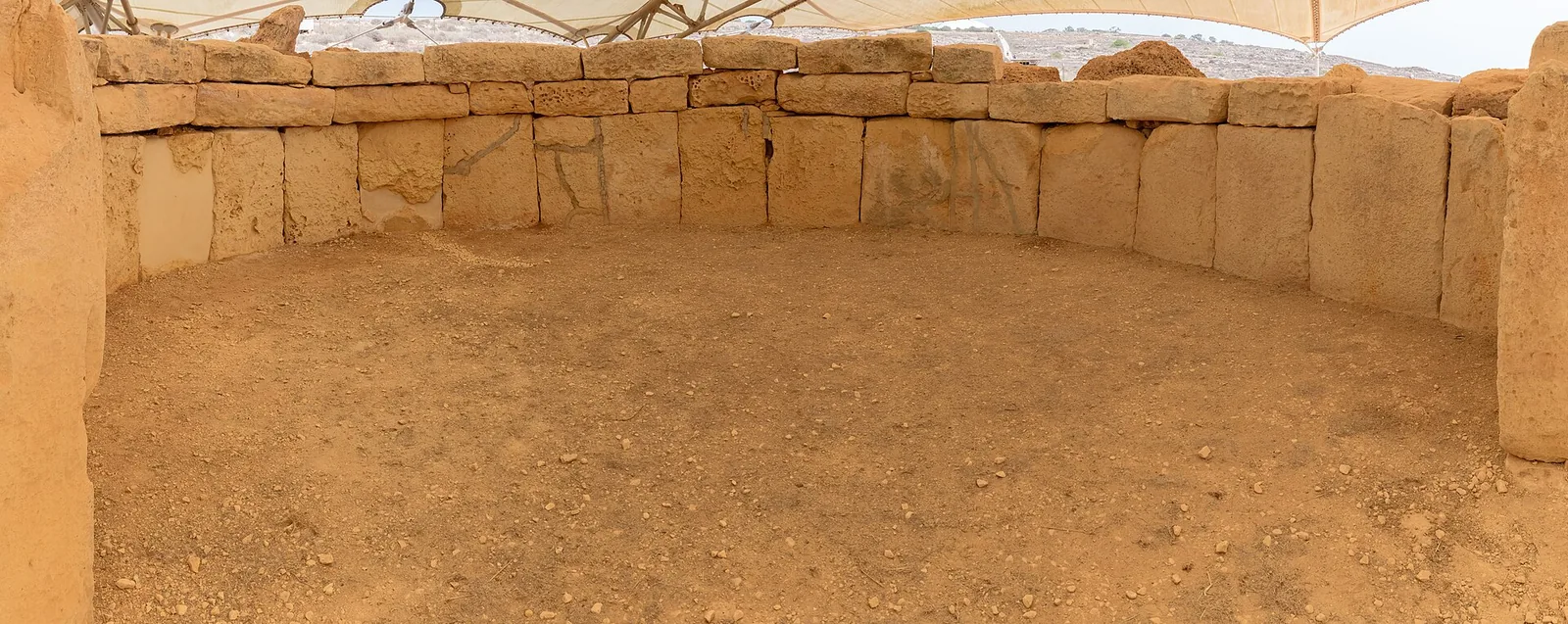
Walk the ten minutes downhill to Mnajdra and you get the single most remarkable thing on the islands. The South Temple is a solar instrument. At sunrise on the spring and autumn equinoxes, light enters the doorway and runs straight down the building’s main axis. At the summer and winter solstices it strikes instead the edges of the megaliths flanking the central passage, left and right. Heritage Malta runs ticketed sunrise events for these dates and they sell out early, so if you want to be inside for one, plan the trip around the calendar rather than the other way round. This is a sacred landscape in the full sense, in the same way that Mount Olympus is not just a mountain: this building was placed, deliberately, in relation to the sky.
Tarxien: the decorated one, and the replica problem
A farmer hit the first stones at Tarxien with a plough in 1913. Themistocles Zammit excavated over the following years and found four temples, three of them from the final phase of the tradition, which archaeologists named after this site. Tarxien is where the art peaks: running spirals, friezes of goats and pigs and a bull, and the lower half of a colossal skirted statue that would have stood over two metres tall.
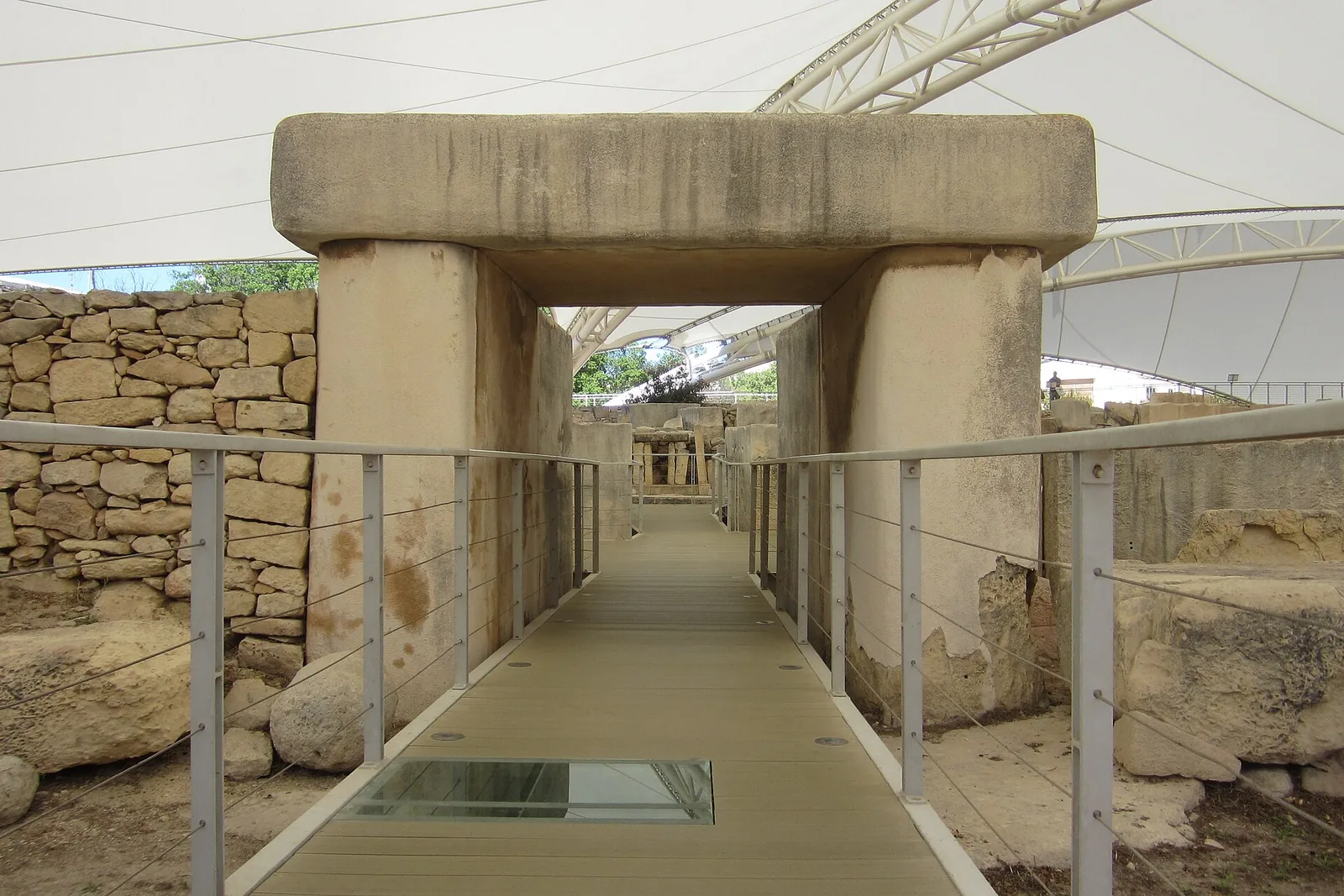
Here is the thing to know before you go, because it catches people out. The carved stones you photograph at Tarxien are copies. The originals were lifted and moved to the National Museum of Archaeology in Valletta, and casts were installed in their place. That is conservation working correctly, not a swindle, but it does change how you plan the day: see the museum and the site together, and see the museum first. The National Museum of Archaeology occupies the Auberge de Provence on Republic Street and holds essentially every important object these islands have produced. An elevated walkway now carries visitors over the Tarxien complex, which protects the floors and, usefully, is the most wheelchair friendly of the six.
Ta’ Hagrat and Skorba: the two nobody visits
Be honest with yourself about these. Ta’ Hagrat in Mgarr village and Skorba at Zebbiegh, a kilometre apart, are small, low and hard to read without a plan in hand. Ta’ Hagrat has a major temple from the Ggantija phase and a much smaller later one, about 6.5 metres long, entered from the larger building’s eastern apse. Skorba matters less for its temple than for what lay under it: village remains and pottery sequences that gave archaeologists the Grey Skorba and Red Skorba phases and the earliest evidence of settled farming on the islands, sickle blades, domesticated animal bone, wheat and barley.
Both keep restricted hours and, critically, neither sells tickets at the gate. Buy online from Heritage Malta or at a Heritage Malta museum before you drive out, or you will stand at a locked fence. For most travellers these are completist stops. For anyone interested in how the temple tradition actually began, they are the two that explain it.
Building it without metal
No metal tools. No wheel in the sense we mean it. The builders quarried limestone with stone hammers and antler picks, moved blocks on spherical stone rollers that still lie around several of the sites, and levelled floors with torba, a crushed limestone plaster that sets almost like cement. The structural vocabulary is post and lintel, the trilithon, plus corbelling where the upper courses step inward to close a space. It is the opposite of the Roman solution: the arch that made the Colosseum possible arrived three thousand years after Ggantija, and the engineered concrete behind Pompeii’s walls later still. Malta’s builders got their scale from mass and geometry alone.
The Hal Saflieni Hypogeum: the hardest ticket in the Mediterranean
Under a residential street in Paola lies a three level burial complex cut down into living rock, the lowest chamber about 10.6 metres below today’s ground level. The remains of roughly 7,000 people were found inside, many of the bones coated in red ochre. The walls carry spirals and honeycomb patterns in the same red pigment, doorways are carved to imitate the trilithons of the temples above ground, and one niche, the so-called Oracle Room, produces an echo that a low voice sets ringing through the chamber. The Sleeping Lady, a small clay figure of a woman lying on a couch, came out of here and now sits in Valletta.
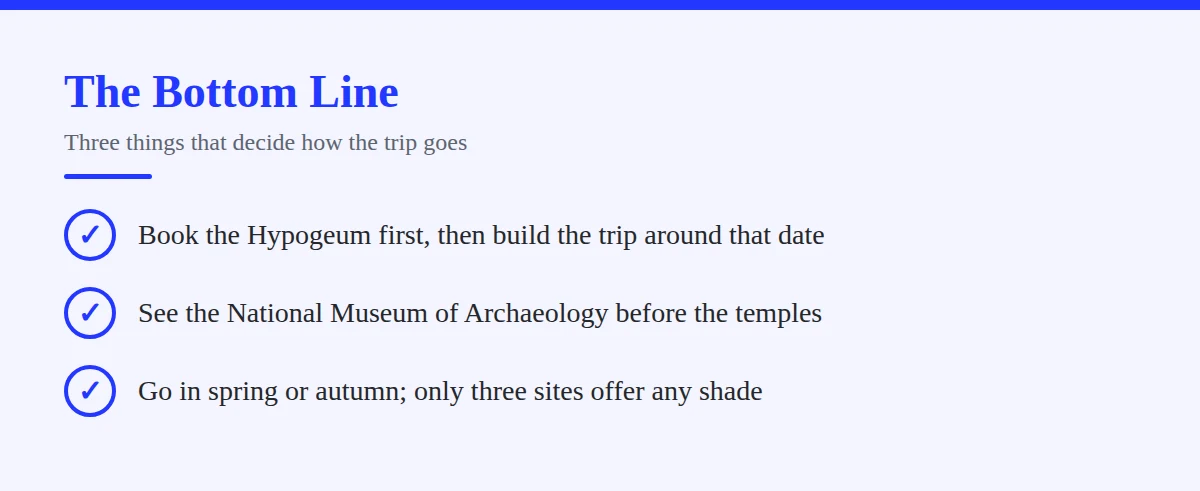
Access is severely rationed to protect the microclimate. Expect roughly 80 visitors a day, in timed groups of about ten, at around 40 euro for an adult ticket, with under sixes not admitted and about an hour underground including the introductory film. Book directly with Heritage Malta two to three months out for summer dates, more if your trip is fixed. A handful of late tickets and cancellations do surface a day or two ahead, but treat that as luck, not a plan. No photography inside, and the stairs make it the least accessible site on the islands.
Fitting it into a trip
Three days covers everything comfortably. Give one day to the south coast for Hagar Qim and Mnajdra, going early because the walk between them is exposed. Give a second to Tarxien, the National Museum of Archaeology and, if you booked in time, the Hypogeum, all within a short hop of each other. Give the third to Gozo and Ggantija, with the ferry and Ta’ Kola built in. Ta’ Hagrat and Skorba slot into a half day in the northwest if you want the full six.
Go in spring or autumn. Summer on these sites is genuinely punishing and only three of them have any shade at all. And go with the museum in your itinerary rather than as an afterthought, because on Malta more than almost anywhere, the buildings and the things found inside them now live in different places. It is the same lesson Crete’s Minoan palaces teach: the ruin gives you the scale, the museum gives you the meaning.
Further reading (sources)
- World History Encyclopedia on the phase by phase sequence of Maltese temple building
- UNESCO World Heritage Centre for the Megalithic Temples of Malta inscription record
- Heritage Malta on visiting the Hagaġar Qim and Mnajdra archaeological park
- European Commission on the protective shelters built over Hagar Qim and Mnajdra
Feature photo by Diego Delso, CC BY-SA 4.0, via Wikimedia Commons.