The Roman Empire Province by Province: The Ultimate Guide to Rome Outside Rome
The best-preserved Roman theatre on earth is in France. The best-preserved Roman town is in Tunisia or Algeria, depending on who you ask. The largest hoard of late Roman gold ever found came out of a Suffolk field, and the frontier you can actually walk end to end runs across northern England. Rome the city holds the empire’s greatest single monuments. Rome the empire, the thing that ran from the Solway Firth to the Euphrates for four centuries, is almost entirely somewhere else, and the average Italy itinerary never touches it.
This is a guide to that somewhere else, organised the way the empire was: by province. Each section gives you the headline sites, the preservation quirk that makes the province worth the flight, and the blunt access reality, because some of the finest Roman cities in existence sit in countries your foreign ministry tells you not to enter.
Learn to read a Roman town, once
The single most useful skill for this kind of travel is not knowing which emperor built what. It is knowing what every Roman town contains, so that a field of broken stone in Algeria reads the same way as one in Northumberland.
A colonia or municipium of any size will have six things, and they sit in predictable relationships to each other:
- The grid. Two main streets crossing at right angles, the north to south cardo maximus and the east to west decumanus maximus, with the rest of the town laid out in rectangular blocks called insulae. Find the crossroads and you have found the centre.
- The forum. At or beside that crossroads: a rectangular paved plaza, colonnaded, with a temple at one short end and a basilica (the law court and business hall, not a church) along one long side.
- The baths. Look for the sequence, because it never varies. Apodyterium (changing room), then frigidarium (cold), tepidarium (warm), caldarium (hot). The hot rooms sit over a raised floor on stacks of small tiles, the hypocaust, with furnace mouths and service corridors behind. Excavators at the sanctuary of Apollo Smintheus in northwest Turkey spent the 2026 season doing exactly this: connecting cold rooms to warm, warm to hot, and tracing the furnaces to work out where the main door was.
- The theatre. Semicircular, seating built into a hillside where the terrain allows, with a tall stage wall (scaenae frons) closing the back. Greek theatres are more than a semicircle and usually free-standing; Roman ones are not.
- The amphitheatre. Fully elliptical, for blood sports rather than drama. A town might have a theatre and no amphitheatre, or both, but the two are never the same building.
- The water. An aqueduct arriving on arches or in a buried channel, a distribution tank (castellum divisorium), then lead and terracotta pipes to fountains, baths and a few rich houses.
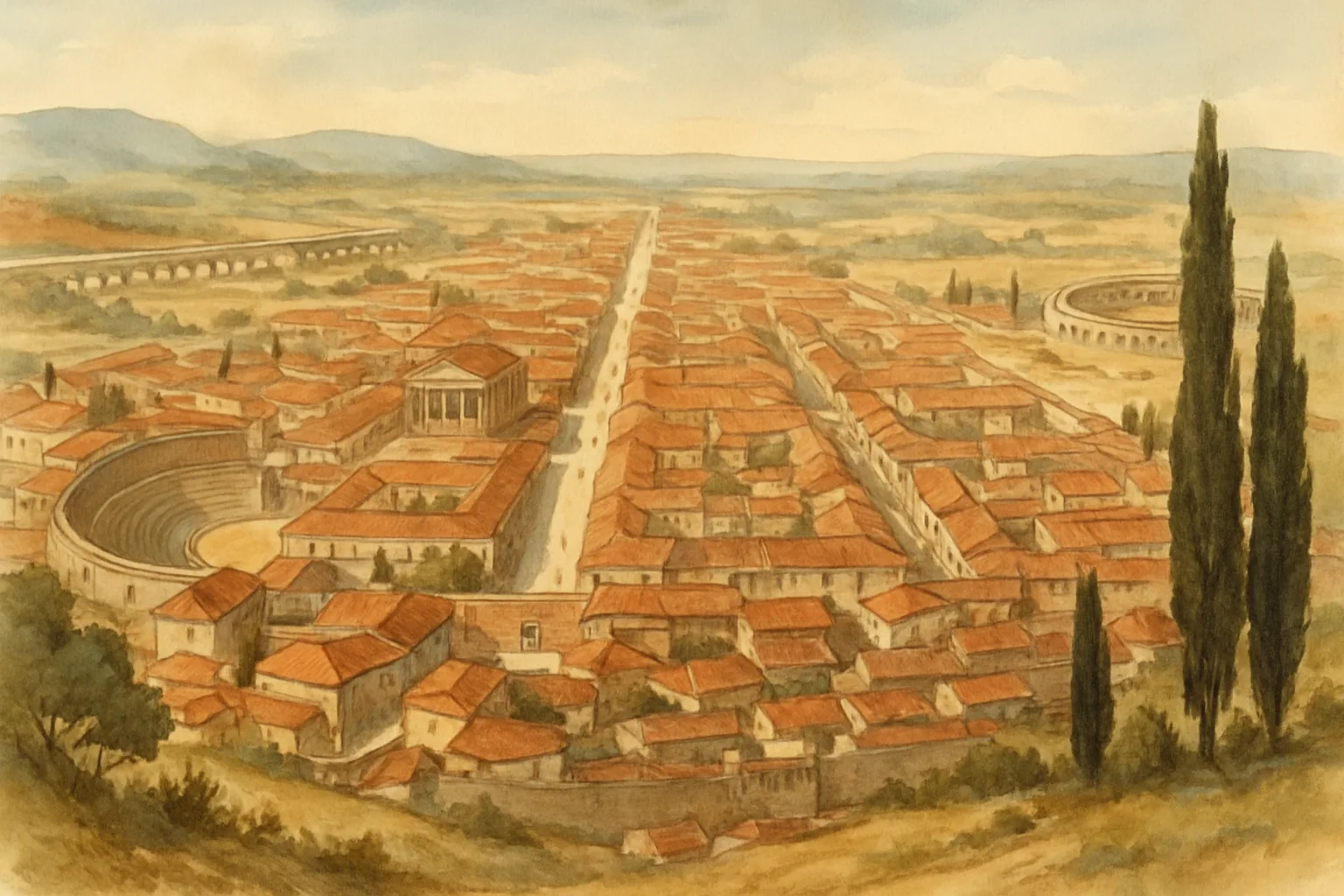
Learn that sequence and you can walk into any site in this guide without a guidebook. What varies province to province is not the plan. It is the building stone, the depth of later occupation, and whether anyone came back and built a medieval town on top.
Gaul: the province that kept its stage wall
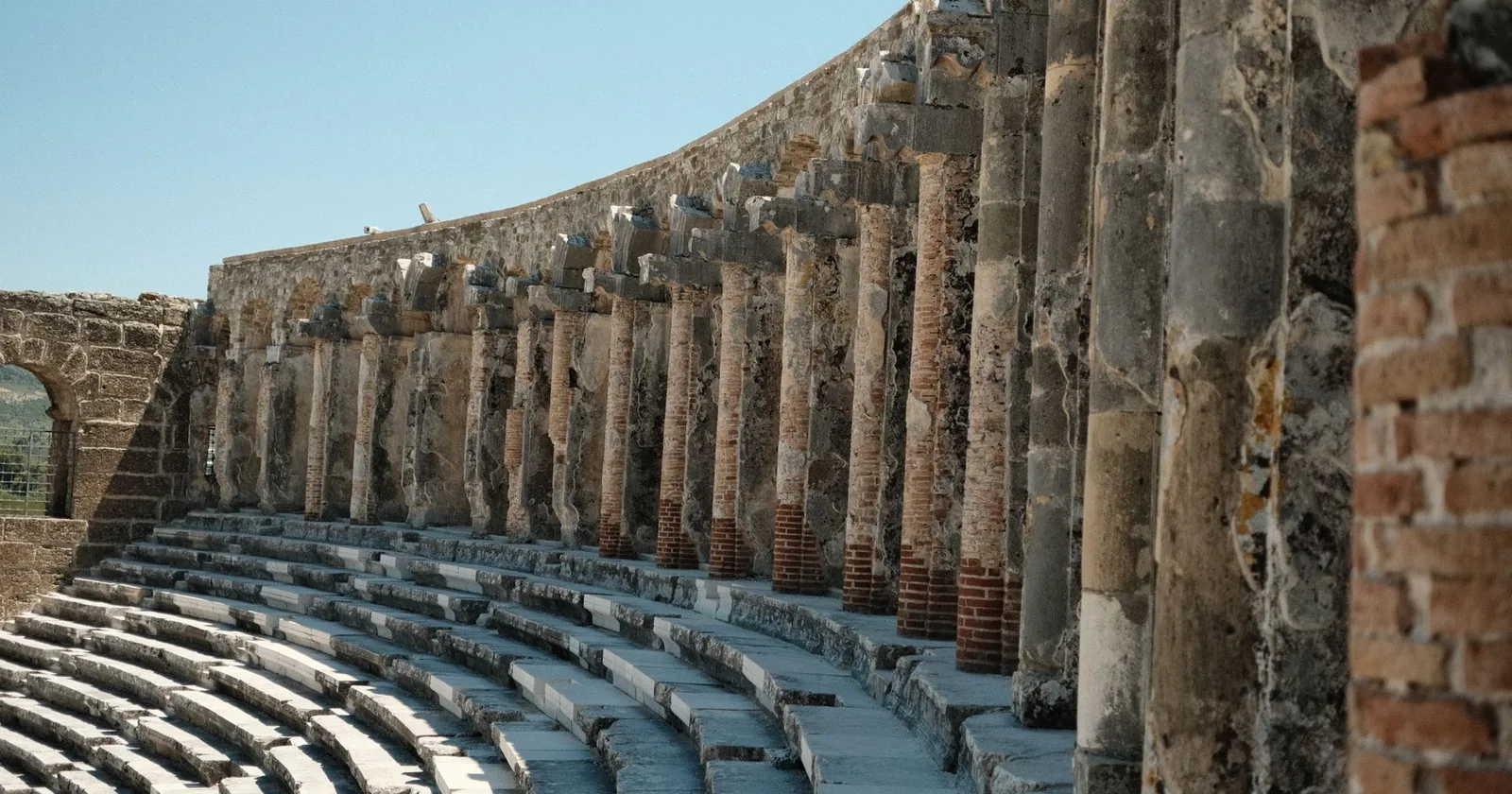
Southern France is the easiest place on earth to start, and it holds the single most astonishing survival in the Roman world. The theatre at Orange, Roman Arausio, was built at the end of the first century AD for around 9,000 spectators, and its stage wall still stands: 103 metres long, 37 metres high, the only Roman stage wall in Europe surviving essentially complete. Louis XIV reportedly called it the finest wall in his kingdom. It went onto the UNESCO list in 1981 and still hosts opera every summer.
Within an hour’s drive you get the rest of the set. Nîmes has an amphitheatre in continuous use and the Maison Carrée, the best-preserved Roman temple anywhere, inscribed in its own right in 2023. The Pont du Gard carries the Nîmes aqueduct 49 metres above the Gardon on three tiers of arches and is the tallest surviving Roman aqueduct bridge. Arles gives you amphitheatre, theatre, cryptoporticus and a genuinely first-rate museum of Roman sarcophagi. Vaison-la-Romaine gives you the domestic quarter that the show-piece cities lack.
North of that, Gaul goes underground. Julius Caesar’s decisive siege of Alesia in 52 BC, where Vercingetorix surrendered and Gallic independence ended, is now a museum and a reconstructed line of siege works in Burgundy. Paris keeps its Roman layer in fragments beneath the modern city, which is what makes the current excavation there so unusual; I covered it in detail in the dig beneath Notre-Dame and where to see Roman Lutetia.
Verdict: best preservation-to-effort ratio in the empire. Fly to Marseille or Nîmes, rent a car, and do not attempt it without one.
Britannia: the frontier you can walk
Britain has no standing Roman city. What it has instead is the most legible military frontier in the world. Hadrian’s Wall, begun around AD 122, runs 73 miles from the Tyne to the Solway, and the Hadrian’s Wall Path lets you walk the whole thing in six or seven days. The forts are the point: Vindolanda, where waterlogged soil preserved the writing tablets that record soldiers asking for socks and underpants; Housesteads, the most complete fort plan in Britain; Chesters, for its cavalry bath house on the North Tyne.
The wall is also the anchor of a much larger idea. It was inscribed in 1987, then joined by Germany’s Upper German-Raetian Limes in 2005 and Scotland’s Antonine Wall in 2008 to form a single transnational World Heritage property called Frontiers of the Roman Empire. Transnational serial listings like this are one of the stranger corners of the system, and worth understanding before you plan around them; our guide to how the World Heritage list works sets out the mechanics.
Elsewhere in the province, Bath preserves the sacred spring and bathing complex of Aquae Sulis, and Fishbourne near Chichester holds the largest collection of in-situ Roman mosaics in the country. Britannia’s other speciality is portable: the Hoxne Hoard, found by a metal detectorist in a Suffolk field in 1992, is the largest cache of late Roman gold known anywhere in the empire. Nearly 15,000 coins and 200 pieces of silver tableware and gold jewellery, deposited in the early fifth century as Roman rule collapsed. It is in the British Museum, and it tells you more about the end of Roman Britain than any wall does.
Verdict: the best province for walkers, the worst for anyone who wants standing architecture.
The Rhine and Danube: the limes as one long site
The continental frontier is where the empire spent most of its money and almost none of its marble. Expect earthworks, timber and reconstruction rather than ruins you can photograph whole.
Go for three things. Xanten in Germany, ancient Colonia Ulpia Traiana, is an archaeological park with full-scale reconstructions built on the original foundations, which is the only honest way to show a mud-brick and timber frontier town. Trier is the exception to everything in this paragraph: an imperial capital with the Porta Nigra, the Aula Palatina, imperial baths and an amphitheatre, all standing, inscribed in 1986. Carnuntum in Austria, near Vienna, has gone further than anywhere else in rebuilding a Roman quarter as a functioning environment, heated hypocausts included.
The Danube Limes (Western Segment), covering components in Germany, Austria and Slovakia, was added to the Frontiers of the Roman Empire property in 2021, the same year as the Lower German Limes in the Netherlands and Germany. The Romanian and Serbian stretches remain on tentative lists.
Verdict: the most rewarding province for people who like understanding systems, the least rewarding for people who want to be impressed.
Hispania: aqueducts and a working theatre
Mérida, Roman Emerita Augusta, is the Roman city Spain does not advertise enough. Its theatre was built under Agrippa’s patronage between 16 and 15 BC, and it still stages a classical drama festival every summer. The archaeological ensemble, UNESCO-listed since 1993, also includes an amphitheatre, a circus, two aqueducts and the Temple of Diana, and the National Museum of Roman Art alongside it is one of the best in Europe. General admission runs about 15 euros, with a combined ensemble pass around 20 euros, and outside the summer festival you can usually walk up.
Segovia’s aqueduct is the other unmissable one: 167 arches of unmortared granite running straight through the middle of a living city, free to see, at any hour, with no ticket at all. Tarragona, ancient Tarraco and the capital of Hispania Citerior, is an easy train from Barcelona and packages its amphitheatre, circus, praetorium and walls into a combined ticket. For something genuinely strange, Las Médulas in León is what remains of the largest gold mine in the empire, a landscape of red pinnacles left behind after Roman engineers collapsed whole mountains using water pressure.
Verdict: the best value in the empire, and the easiest to do by train.
Africa Proconsularis and Numidia: the best-preserved Roman cities anywhere
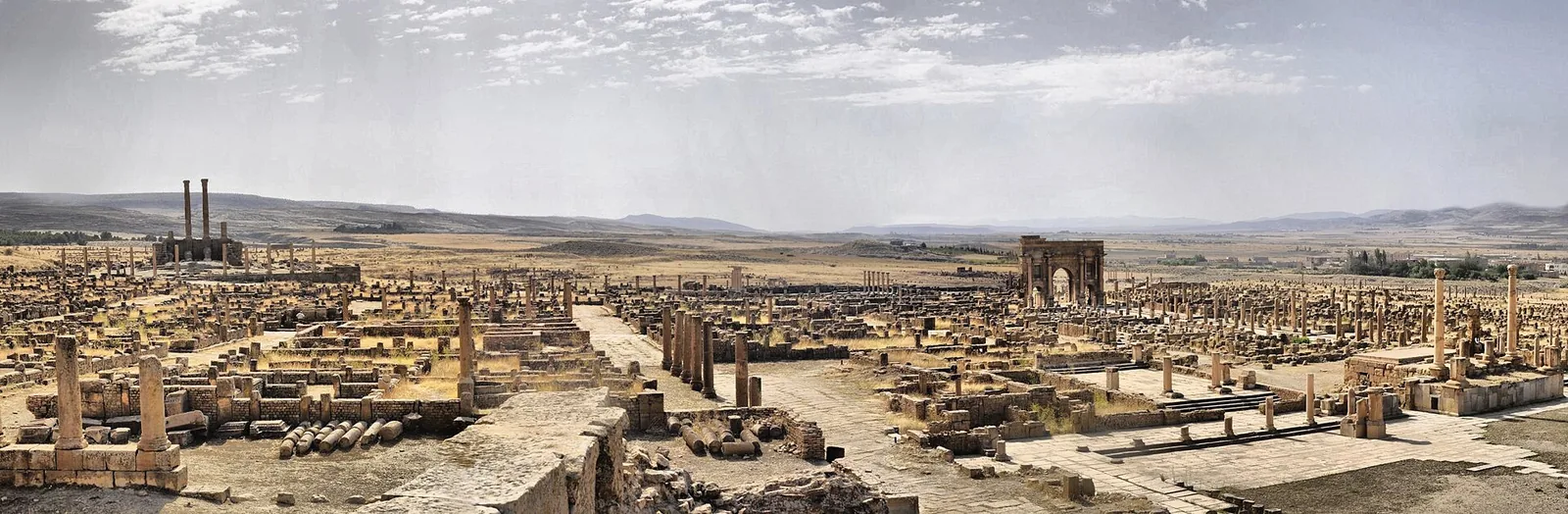
If you only care about how much of a Roman town is still standing, North Africa wins and it is not close. The province was the empire’s grain basket, its cities were rich, and after the seventh century very few of them were built over.
Tunisia is the accessible half. Dougga, ancient Thugga, is generally reckoned the best-preserved Roman town in North Africa, with its Capitol standing nearly complete on a hillside above olive country. El Djem’s amphitheatre held around 35,000 people and is the third largest in the Roman world. Add Bulla Regia, where the wealthy built entire underground floors with mosaics to escape the summer heat, and Carthage itself.
Algeria is the connoisseur’s half, and requires a visa and a little patience. Timgad, founded by Trajan around AD 100 as a colony for veterans, is the textbook Roman grid city, so regular it is used to teach urban planning; entry is a couple of euros. Djemila, ancient Cuicul, is set in spectacular hill country and open daily. Tipaza sits on the coast.
Libya holds the two greatest sites of all, and the hardest problem. Leptis Magna, birthplace of Septimius Severus, and Sabratha on the coast are Roman cities of a scale and completeness that nothing in Italy outside Pompeii matches. Tourism collapsed after 2011 and has only partly returned, so the crowds are effectively zero. But the US State Department and the UK FCDO both advise against travel to Libya, independent travel by foreigners is not possible, and every visitor must be accompanied by a licensed operator and official escort as a condition of the visa. Treat any Libya plan as a security decision first and a heritage decision second.
Verdict: the highest preservation ceiling in the empire, with access ranging from straightforward (Tunisia) to genuinely restricted (Libya).
Asia and the East: marble, and the access problem
Roman Asia, the western third of modern Turkey, is where the empire spent on marble. Ephesus takes around 2.5 million visitors a year and is Turkey’s most visited ancient site; foreigner admission is about 40 euros, or 52 with the Terrace Houses and the Ephesus Experience. Less than 15 percent of it has been excavated. Aphrodisias, Pergamon, Hierapolis and Sagalassos are all quieter and all superb, and Turkish excavation is unusually active right now: a 2,000-year-old frigidarium pool roughly 37 by 12 metres, with capacity for about 300 bathers, was uncovered in the gymnasium complex at Tralleis in August 2026.
Further south the picture splits sharply. Jordan is easy and outstanding: Jerash is one of the best-preserved provincial Roman cities anywhere, with a colonnaded oval forum, two theatres and a hippodrome, and it pairs naturally with Petra. Lebanon holds Baalbek, whose Temple of Bacchus is larger than the Parthenon, but Lebanon carries a Level 4 “do not travel” advisory and the Bekaa Valley is specifically named; a UNESCO mission assessed hostility damage at the site in March 2025. Syria reopened to international visitors after December 2024, and Palmyra can be reached, but the site remains scarred by ISIS demolitions and a decade of war, damage assessment is incomplete, and infrastructure is minimal.
Verdict: Turkey and Jordan belong on any serious Roman itinerary. Lebanon and Syria are for travellers who follow security advice closely and accept the answer.
Dacia: the province Rome bought with gold
Trajan’s two Dacian wars, AD 101 to 102 and 105 to 106, are carved in spiral relief up Trajan’s Column in Rome, and the gold that paid for the Forum of Trajan came from what is now Romania. The Dacian Fortresses of the Orastie Mountains, six sites inscribed in 1999, are the losing side of that story: Sarmizegetusa Regia, the Dacian capital, with its rectangular and circular sanctuaries and stone solar disc, plus Costesti, Blidaru, Piatra Rosie, Banita and Capalna. Ulpia Traiana Sarmizegetusa, the Roman colony founded afterwards some 40 km away, is the winning side.
Check before you drive. Sarmizegetusa Regia closed on weekdays from 4 May to 30 June 2026 for conservation work on Terrace X, with weekend access only, and this kind of rolling restriction is normal there.
Verdict: the most atmospheric province, the thinnest architecture, and the one that most rewards reading the history first.
Ranking them honestly
By preservation: North Africa (Libya, then Tunisia and Algeria), then Asia, then Gaul, then Hispania, then Dacia, then the Rhine and Danube.
By ease of access: Gaul and Hispania, then Britannia, then the Rhine and Danube, then Asia and Jordan, then Tunisia, then Algeria, then Syria and Lebanon and Libya.
By crowd load: Ephesus is the only site in this guide with a genuine crowding problem. Almost everywhere else, arriving at opening solves it, and in Algeria and Libya you may have a World Heritage city to yourself.
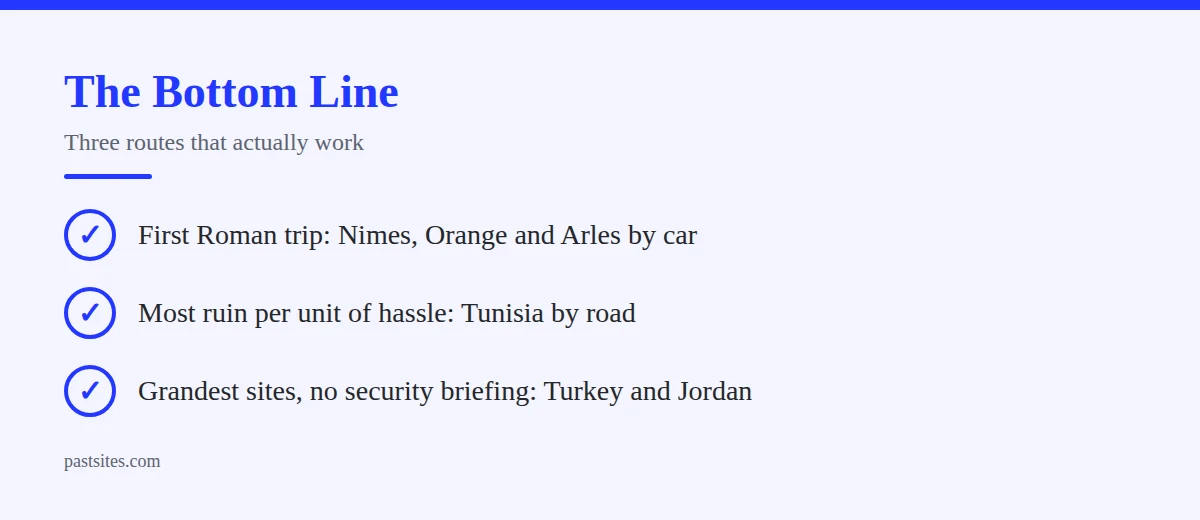
Put the two rankings together and the sweet spots are obvious: Tunisia for maximum ruin per unit of hassle, southern France for a first trip, Turkey and Jordan for the grandest single sites you can visit without a security briefing.
How to build the trip
Pick one province per week and stop trying to link them. The empire’s road network does not help you now; modern flight routes do, and they run through capitals rather than along frontiers.
Two combinations work particularly well. Tunis to Dougga, El Djem and Bulla Regia is a week with a car and no internal flights. Nîmes to Orange, Arles, the Pont du Gard and Vaison is the same again in France, with better food and worse ruins.
And read the construction before you go. Knowing why Roman concrete outlasted everything built after it, which Pompeii’s frozen building site explains better than any other excavation, changes what you notice at every one of these sites. So does an hour in the Colosseum understanding what a Roman crowd building had to solve. If your route crosses the central Mediterranean, it is worth remembering how shallow the Roman layer is in the wider story: Malta’s megalithic temples were already 3,000 years old when the legions arrived.
Further reading (sources)
- World History Encyclopedia on the Roman theatre of Arausio and its 103-metre stage wall
- World History Encyclopedia for the Hoxne Hoard, the largest late Roman gold cache in the empire
- UNESCO World Heritage Centre keeps the record for the Danube Limes Western Segment
- UNESCO World Heritage Centre on the Dacian Fortresses of the Orastie Mountains
- Archaeology Magazine reporting the cold pools and changing room found at the Apollo Smintheus bathhouse
- The Jerusalem Post for the Roman pool and mosaic uncovered at Tralleis
- Romania Insider with the 2026 conservation closure at Sarmizegetusa Regia
- NPR on Syria’s hopes of bringing visitors back to Palmyra
Feature photo by Tahir Osman on Pexels.